
Standing out in 2026 requires more than a good reputation. It requires a deliberate, multi-channel marketing strategy — one that matches how your ideal clients actually search for, evaluate, and hire consultants.
This guide covers digital foundations, content and thought leadership, social media and paid advertising, referrals and community outreach, and how to measure what's actually working. Whether you're building your practice from scratch or scaling an established firm, each section includes actionable steps you can implement immediately.
Key Takeaways
- Build a mobile-first website optimized for the intent-driven search terms your clients use — not just generic "immigration consultant" phrases.
- Publish educational content that demystifies visa processes and processing timelines, positioning you as the go-to authority before prospects ever reach out.
- Use LinkedIn to reach HR leaders, mobility teams, and corporate decision-makers; layer paid ads for high-intent B2B leads.
- Referrals, Google reviews, and professional partnerships are the highest-ROI trust-builders in this space — most consultants aren't using them.
- Track lead volume, conversion rate, and cost per acquisition monthly; adjust channel spend based on data, not instinct.
Why Immigration Consultant Marketing Requires a Different Playbook
The Trust Gap Is Real
Most service industries sell convenience or savings. Immigration consulting sells something different: certainty in an uncertain process. Clients aren't comparing prices — they're evaluating whether they can trust you with decisions that affect their ability to work, stay, or reunite with family.
Promotions and discounts signal the wrong things in this context. What builds pipeline is credibility — credentials prominently displayed, real outcomes communicated clearly, and educational content that demonstrates competence before a single conversation takes place.
Over 80% of business decision-makers say thought leadership increased their trust in a vendor. That statistic was collected from corporate buyers — exactly the HR directors and global mobility managers that B2B-focused immigration consultants need to reach.
The Dual Audience Challenge
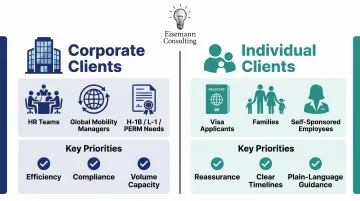
Immigration consultants often serve two very different client segments with very different needs:
- Corporate clients — HR teams and global mobility managers overseeing H-1B, L-1, or PERM sponsorships at scale
- Individual clients — visa applicants, families navigating reunification, or employees managing their own immigration status
Each segment requires a different message, a different channel, and a different tone. A corporate HR director wants operational efficiency, compliance certainty, and volume capacity. An individual applicant wants reassurance, clear timelines, and someone who will explain the process in plain language. Marketing that tries to speak to both simultaneously usually resonates with neither.
Firms like Eisemann Consulting, which focus exclusively on B2B corporate and mid-market clients, take the decision off the table entirely — every message, every channel, every content piece is built for HR professionals and mobility teams, not individual applicants.
Regulatory Sensitivity as a Competitive Advantage
Non-attorney immigration consultants face strict, state-level restrictions on what they can claim in marketing. Key examples:
- California: Consultants cannot represent themselves as attorneys or provide legal advice
- Arizona: Violations can reach felony status, with civil penalties up to $1,000 and mandatory license revocation
- Multiple states: Use of terms like "notario" in advertising is prohibited entirely
The narrow but powerful path: focus your marketing on education, process guidance, and operational support. Content about processing timelines, compliance procedures, and policy changes builds trust and authority without crossing into unauthorized practice territory. Transparency about what you do — and don't — provide isn't just a legal requirement. It's a differentiation strategy.
Build Your Digital Foundation: Website and Local SEO
Your digital foundation runs on two tracks: a website that converts skeptical visitors into booked consultations, and local SEO that puts you in front of the right searches. Get both right, and you're building a lead engine that works without a marketing budget. Miss either one, and you're leaving qualified prospects on the table.
What Makes an Immigration Consultant Website Work in 2026
Your website has one job before anything else: convert a skeptical visitor into a booked consultation. That means:
- Clear service descriptions — what visa categories you handle, what the process looks like, who you serve
- Credentials and bio front and center — years of experience, designations, notable clients or outcomes
- Client testimonials with specific outcomes (cost savings, timelines met, complexity handled)
- Mobile-first design — 84% of local searches happen on mobile devices, and 88% of mobile searchers contact a business within one day
- Fast load times — Google penalizes slow sites in local rankings
- Intake forms that feed directly into a CRM, not just an email inbox
Eisemann Consulting's website, for example, uses a smart-routing inquiry form that captures company size, timeline, and budget range, then routes submissions to the right service category automatically. The result: fewer dropped leads, faster follow-up, and a first impression that signals operational competence before the first call.
Local SEO: Start With Google Business Profile
If you serve clients in a specific metro area, your Google Business Profile is the single highest-ROI free action available. Businesses with complete profiles receive 7x more clicks and are 2.7x more likely to be viewed as reputable than those without one.
The stakes are steep: the top three local pack results capture 93% of all local pack clicks. Position four is functionally invisible.
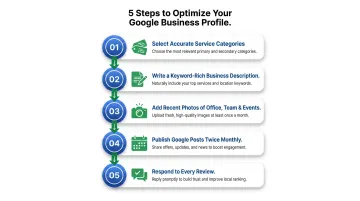
Optimize your profile by:
- Selecting accurate primary and secondary service categories
- Writing a keyword-rich business description that includes your key visa specialties
- Adding recent photos (office, team, events)
- Publishing Google Posts at least twice monthly with policy updates or tips
- Responding to every review, positive and negative
Long-Tail Keywords Drive Better Leads
Broad terms like "immigration consultant" are competitive and attract wide, unqualified traffic. Long-tail phrases attract people who are ready to act:
- "H-1B visa consultant near me"
- "corporate immigration consultant Texas"
- "PERM labor certification help [city]"
- "L-1 visa compliance audit [state]"
These searchers have already decided they need help — they're evaluating who to hire. In most markets, ranking for five long-tail phrases with clear commercial intent will drive more qualified consultations than a single broad-term ranking ever could.
Keyword strategy and on-page optimization only go so far — off-site signals matter too, and citations are where many consultants leave easy authority on the table.
Directory Listings and Citations
Consistent NAP (name, address, phone number) across all listings signals authority to search engines. The platforms that move the needle most:
- Google Business Profile
- LinkedIn Company Page
- Bing Places
- Local Chamber of Commerce directory
- Industry-specific directories (CAPIC for Canadian consultants)
Note: Avvo and Justia are attorney-only platforms. Non-attorney immigration consultants cannot create listings there — don't waste time pursuing them.
Content Marketing and Thought Leadership for Immigration Consultants
Why Content Outperforms Paid Ads Over Time
A well-optimized blog post answering "How long does PERM labor certification take in 2026?" keeps generating traffic for years. A Google Ad stops when the budget does. HubSpot's research across 15,000+ companies found that the top 10% of posts — the "compounding" ones — generate 38% of total blog traffic, with a single strong post delivering 2.5x monthly visits within six months.
Organic customer acquisition costs for consulting firms average $512 versus $1,044 for paid channels — roughly half the cost, for clients who tend to have higher lifetime value and stronger referral potential.
Content Types That Work
Long-form how-to guides (build compounding organic traffic over 12–24+ months):
- "What HR Teams Need to Know About H-1B Cap Season"
- "PERM Labor Certification: A Step-by-Step Timeline"
- "L-1 vs. H-1B: Which Visa Fits Your Hiring Needs?"
Timely policy update posts (fastest to rank for news-based searches):
- USCIS processing time changes
- DOL rule updates
- Enforcement policy shifts (ICE site visits, compliance audits)
FAQ-format content addressing cost and timeline objections before they come up in sales conversations.
Case study or success story posts with client permission — specific outcomes (cost saved, timelines met, complexity resolved) outperform generic testimonials.
Eisemann Consulting's blog takes this approach directly, publishing content like "What does the new H-1B cap lottery salary prioritization really mean?" in response to DHS policy changes — the kind of timely analysis that answers what HR teams are already searching for before they pick up the phone.
Building a Content Calendar That Compounds
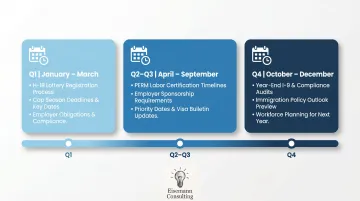
Align monthly topics with the natural rhythm of immigration deadlines:
| Quarter | Focus Topics |
|---|---|
| Q1 (Jan–Mar) | H-1B cap season — lottery process, registration deadlines, employer obligations |
| Q2–Q3 (Apr–Sep) | PERM and green card — processing timelines, employer requirements, priority dates |
| Q4 (Oct–Dec) | Year-end compliance audits, policy outlook for the coming year |
Pair each blog post with a LinkedIn article variant, a short social post, and a slot in your monthly email newsletter. This distribution habit is what separates firms that publish from firms that actually get found.
On-Page SEO and CTAs That Convert
Every piece of content needs both traffic potential and conversion mechanics:
- Include your target keyword in the H1, at least one H2, and the meta description
- Link internally to your relevant service pages
- Embed a clear call-to-action within the content body — "Schedule a compliance review," "Download our H-1B checklist"
- Aim for 1,000–1,500 words on core topics; shorter posts rarely rank on competitive immigration queries where searchers expect substantive answers
Social Media, Paid Ads, and Lead Generation
Choosing the Right Platforms for Your Audience
The platform split for immigration consultants is clear:
| Audience | Primary Platform | Secondary |
|---|---|---|
| HR teams, global mobility managers | ||
| Individual visa applicants, families | Facebook, Instagram | YouTube |
| Both | LinkedIn + Facebook | YouTube/TikTok for video |
LinkedIn accounts for 80% of all B2B social media leads, and 89% of B2B marketers rely on it for lead generation. For consultants targeting corporate clients, LinkedIn isn't optional — it's the primary organic channel.
The 70/20/10 content rule works particularly well in immigration, where audiences need to trust you before they engage:
- 70% — Educational content: policy explainers, visa process walkthroughs, compliance tips
- 20% — Curated or community content: industry news, client milestones, relevant announcements
- 10% — Direct promotional content: service announcements, consultation CTAs
Lead with value consistently, and the 10% promotional content actually gets read.
Paid Advertising That Converts
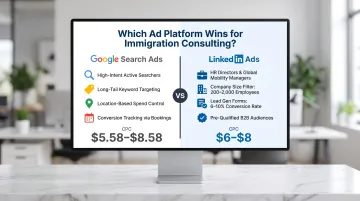
Google Search Ads are best for capturing high-intent searchers actively looking for help right now. Key setup requirements:
- Target long-tail, high-intent keyword phrases
- Use location targeting to limit spend to your service area
- Set up conversion tracking linked to consultation bookings, not just clicks
- Expect CPCs in the $5.58–$8.58 range (business services to legal services benchmarks per WordStream 2025)
LinkedIn Ads cost more per click but deliver pre-qualified corporate audiences Google simply can't reach. Key setup parameters:
- Expect $6–$8 CPC for consulting and professional services
- Target HR Director, Global Mobility Manager, and VP of People roles
- Focus on companies with 200–2,000 employees for B2B immigration work
- LinkedIn Lead Gen Forms convert at 6–10% for professional services — roughly 2–3x higher than a standard landing page
Run paid campaigns during peak seasons (H-1B cap in Q1, PERM filing surges) while building the evergreen content library that compounds traffic year-round.
Referrals, Reviews, and Community Trust-Building
The Review Situation in 2025
Trust in reviews has declined — only 42% of consumers now trust online reviews as much as personal recommendations, down from 79% in 2020. But that doesn't mean reviews matter less. 96% of consumers still read reviews, and 74% now cross-reference multiple platforms before deciding.
What this means practically: a few negative reviews are harder to offset with volume. Quality and recency matter more than accumulating raw numbers. Build a systematic review-request process:
- Send a review request email 3–5 days after case close or engagement completion
- Include a direct link to your Google Business Profile review form
- Keep the ask simple: "If you're satisfied with the work, a quick review would mean a lot — here's the link"
- Respond to every review within 48 hours
Referral Networks Are Massively Underused
69% of professional services clients are willing to make referrals. 72% are never asked. That gap is where most consulting practices leave their easiest growth on the table.
Build referral relationships with professionals who regularly interact with your ideal clients:
- Employment attorneys (they need immigration support for corporate clients)
- HR consultants and PEO providers
- Relocation management companies
- CPAs and benefits advisors serving international employees
- Global mobility associations (SHRM has nearly 340,000 members; Worldwide ERC's annual conference draws thousands of global mobility professionals)
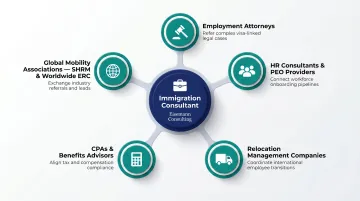
Approach each partnership with a clear value exchange: explain what you handle, what you refer out, and offer to reciprocate. A brief introductory conversation is enough to start.
Community Trust-Building
Digital marketing reaches scale; in-person relationship-building closes high-value clients. Specific actions that work:
- Speak at SHRM or Worldwide ERC events (WERC Global 2026 is October 27–30 in Chicago)
- Host "HR Compliance Essentials" workshops for local business associations
- Sponsor cultural events relevant to the communities you serve
- Participate in local Chamber of Commerce activities
These aren't just networking activities — they build the kind of credibility that converts enterprise-level clients. Julie Eisemann's recognition among the Global Mobility Top 250 Women Leaders and her work on Amazon's Welcome Door refugee hiring initiative are concrete examples: credentials earned through participation, not purchased through a campaign.
Measuring and Optimizing Your Marketing ROI
The Metrics That Matter
Track these monthly, by channel:
| Metric | What It Tells You |
|---|---|
| Total leads by source | Which channels are generating pipeline |
| Consultation booking rate | Website and profile conversion quality |
| Lead-to-client conversion | Sales process effectiveness |
| Average client value | Which segments are worth more to acquire |
| Cost per acquisition | Whether paid channels are worth continuing |
The professional services average conversion rate is 4.6% (VWO, 2026). If your consultation booking rate is significantly below that, the problem is usually website clarity or intake friction — not channel volume.
A Simple Measurement Stack
You don't need enterprise-grade software to start:
- Google Analytics — website traffic, goal completions, source attribution
- Google Search Console — keyword rankings, impressions, click-through rates
- Google Business Profile Insights — local search visibility, direction requests, calls
- CRM or tracking spreadsheet — log every lead source manually if needed until you automate
Automation has a direct impact on how much time you can actually spend on marketing. Salespeople spend nearly 70% of their week on administrative tasks — only 30% on actual selling. Unified CRM data can bring daily admin time from 5 hours down to 30 minutes.
That's where intake automation and case workflow tools earn their place. Eisemann Consulting offers email automation and case document workflow services starting at $1,000–$1,500, built specifically for immigration and mobility consultants looking to reclaim that time.
Review Cadence
- Monthly: Check lead volume by channel, booking rate, and conversion. Spot trends early.
- Quarterly: Reallocate budget toward what's performing. Cut or pause underperforming channels.
- Annually: Refresh your full marketing plan aligned with immigration policy cycles and growth targets.
Frequently Asked Questions
How do you market immigration services?
Build a professional website with clear service descriptions, publish educational content that answers the questions your target clients are already searching for, and maintain an active LinkedIn presence where corporate decision-makers evaluate advisors. Pair that with a referral network of HR consultants, relocation firms, and employment attorneys. Every channel should reinforce trust — it's the foundation all other tactics build on.
How do you get clients for immigration consulting?
For B2B immigration consulting, the fastest path combines two moves: optimize your LinkedIn presence and Google Business Profile for visibility, then build direct relationships with HR leaders, in-house mobility teams, and employment attorneys who regularly need your expertise. Both have minimal upfront cost and compound over time.
What is the 70/20/10 rule for social media?
Roughly 70% of your posts should educate or add value (policy updates, visa tips, process walkthroughs), 20% should share curated industry content or celebrate community milestones, and 10% can directly promote your services. The ratio works especially well in immigration consulting because decision-makers need to see consistent expertise before they engage. Showing up as a reliable resource builds the credibility that makes your 10% promotional content land.
What are the 5 P's of marketing strategy?
Product (your specific visa and mobility services), Price (transparent engagement structures that signal confidence), Place (the channels where HR teams and mobility leaders evaluate advisors), Promotion (the content, outreach, and referrals that generate awareness), and People (the enterprise credentials, operational track record, and advisory experience clients expect when the stakes are high). In immigration consulting, People often does the heaviest lifting.
How do you write a marketing plan for an immigration consulting business?
Start by defining your ideal client and what makes your practice the clear choice for them. Pick 2–3 primary channels, set measurable KPIs (leads, bookings, conversion rate, cost per acquisition), and build a content calendar aligned with immigration policy cycles. Schedule quarterly reviews to adjust based on actual data, not original assumptions.