
You need operational leadership. But a full-time COO commands upward of $300,000+ per year in base salary alone — before benefits, recruiting fees, or equity. That math doesn't work for most mid-market companies.
That's where the fractional COO model comes in. This article covers everything you need to know: what a fractional COO actually does, what it costs, and how to hire one who delivers results.
Key Takeaways
- A fractional COO provides COO-level operational leadership on a part-time or contract basis — same expertise, fraction of the cost
- They translate CEO vision into execution, fix broken processes, manage teams, and build systems that support scale
- Monthly retainers typically run $3,000–$15,000, versus $400,000+ annually for a full-time hire
- Ideal for growing companies where operations are breaking down but a full-time executive hire isn't justified yet
- A focused engagement can stabilize operations, align teams, and build scalable systems within 90 days
What Is a Fractional COO?
A fractional COO is an experienced operations executive who works with a company on a part-time, contract, or project basis — delivering COO-level strategy and execution without full-time employment.
The CEO sets direction and long-term vision. The fractional COO translates that vision into an operational plan, holds day-to-day execution accountable, and acts as the CEO's operational right hand — without sitting in the office five days a week.
Most fractional engagements run 10–40 hours per month, depending on scope. There's no benefits package or equity dilution — just the expertise, on your terms.
Who typically uses fractional COOs:
- Post-fundraise startups building operational infrastructure for the first time
- Mid-market companies scaling past the point where the CEO can manage everything
- Businesses in transition — new markets, acquisitions, restructures
- Companies that need enterprise-grade operational rigor but aren't sized for a full-time C-suite hire
The fractional model has grown sharply. According to Vendux's 2026 market analysis, 25% of U.S. businesses now use fractional hiring, with demand growing 46% year over year. Gartner projects that 30%+ of midsize enterprises will have at least one fractional executive on retainer by 2027.
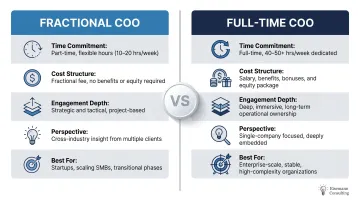
Fractional COO vs. Full-Time COO
| Dimension | Fractional COO | Full-Time COO |
|---|---|---|
| Time commitment | 10–40 hrs/month | 160–200 hrs/month |
| Cost structure | Hourly or monthly retainer | Salary + benefits + equity |
| Engagement depth | Project or phase-based | Fully embedded |
| Perspective | Cross-industry pattern recognition | Deep company-specific knowledge |
| Best for | Growing companies, defined phases | Mature orgs, ongoing complexity |
Neither model is universally better. The real question is whether your current scale justifies a fully embedded executive — or whether focused, senior-level operational leadership on a defined engagement would move the needle faster right now.
Key Responsibilities of a Fractional COO
Responsibilities vary by engagement, but most fractional COOs are brought in to handle a core set of operational functions that would otherwise fall to the CEO — or not get done at all.
Strategic Planning and Execution
The fractional COO works directly with the CEO to convert high-level business goals into actionable operational plans. This includes prioritizing initiatives, setting timelines, and ensuring different departments are aligned rather than pulling in different directions.
Harvard Business Review's analysis of the COO role identifies the primary archetype as "the executor" — the person who leads the execution of strategies the CEO develops. That's exactly what a strong fractional COO delivers.
Process Optimization and Workflow Design
This is where fractional COOs create the fastest, most visible impact. They audit existing operations to find bottlenecks, redundancies, and manual inefficiencies — then redesign processes for speed and scale.
Modern fractional COOs pair this work with AI-powered automation and low/no-code tools. Eisemann Consulting's engagements, for example, have produced documented results including a 60% reduction in manual touchpoints and 45% faster cycle times through workflow redesign — with one client case study showing order fulfillment time cut from five days to one day after an operational overhaul.
Team Management and Organizational Structure
Fractional COOs take on people-related accountability: managing department heads, identifying skill gaps, introducing performance frameworks, and structuring teams to support the next stage of growth. This frees the CEO from being the default escalation point for every internal problem.
KPI Establishment and Reporting
Many growing companies make decisions based on gut feel rather than data. A fractional COO introduces the right KPIs, builds reporting cadences, and ensures leadership has real-time visibility into operational performance. The Scalability Accelerator engagement at Eisemann Consulting, for instance, includes KPI dashboards and quarterly scaling reviews as standard deliverables.
Risk Management and Contingency Planning
Because fractional COOs work across multiple companies and industries simultaneously, they spot patterns other executives miss. They surface operational, financial, and compliance risks before those risks become crises, then build the controls and contingency plans that keep the business on track.
Top Benefits of Hiring a Fractional COO
Cost-Effective Access to Executive Expertise
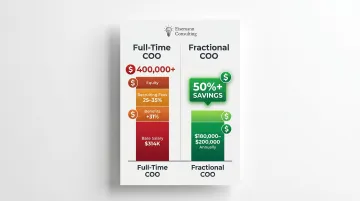
Glassdoor data puts the average full-time COO salary at approximately $314,000 per year in the United States. Stack on the full cost of employment and the number climbs fast:
- Benefits: ~31% of total compensation (BLS data)
- Recruiting fees: 25–35% of first-year comp
- Equity: typically 2–5% of company at post-Series A stage
Total cost of a full-time COO: $400,000+ annually.
A fractional COO working roughly two days per week runs approximately $180,000–$200,000 annually — a 50%+ reduction for the same caliber of operational leadership. That difference funds a product hire, a marketing push, or an infrastructure upgrade.
Fresh Perspective and Cross-Industry Experience
Fractional COOs work across multiple companies at once, and that breadth compounds into a real advantage. They've seen the same bottleneck in four different industries. They know which fixes hold and which ones create new problems downstream. Most importantly, they ask the questions your internal team stopped asking years ago.
An operations manager who's grown up inside the company often can't see the inefficiencies they've normalized. A fractional COO with experience across industries sees them immediately.
Flexible Engagements That Scale With Your Business
Fractional arrangements are built for flexibility. Engagement hours ramp up when the business demands it and scale back when things stabilize — you pay for the operational leadership you need, when you need it.
High-demand triggers that typically warrant increased hours include:
- Fundraising rounds or investor due diligence
- Product launches or go-to-market execution
- International expansion or new market entry
- M&A activity or post-merger integration
73% of companies cite access to specialized skills they lack internally as the primary reason for using fractional executives. The on-demand model is what makes that access affordable.
Faster Time to Impact
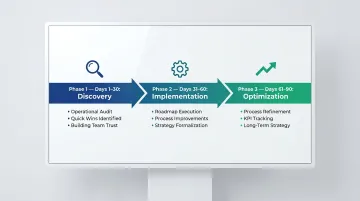
Experienced fractional COOs don't need six months to get up to speed. They're practiced at fast diagnosis and faster execution. A well-structured 90-day engagement typically looks like this:
- Days 1–30 (Discovery) — Operational audit, cultural immersion, identifying quick wins, building team trust, gaining system access
- Days 31–60 (Implementation) — Executing the roadmap, prioritizing high-impact process improvements, formalizing strategy
- Days 61–90 (Optimization) — Refining new processes, establishing sustainable KPI tracking, delivering long-term operational strategy
How Much Does a Fractional COO Cost?
Costs vary based on the executive's experience, industry specialization, and hours committed per month. Here are the current market ranges:
| Pricing Model | Typical Range | Best For |
|---|---|---|
| Hourly rate | $150–$500/hour | Variable, project-specific work |
| Monthly retainer | $3,000–$15,000/month | Ongoing engagements, predictable cost |
| Project fee | Fixed scope + price | Defined deliverables (system overhaul, process redesign) |
Monthly retainers are the most common model for ongoing fractional COO engagements — they provide cost predictability for the company and guaranteed availability from the executive.
To put those ranges in practice: Eisemann Consulting's Scalability Accelerator — a three-month engagement covering fractional COO advisory, process mapping, KPI dashboards, and workflow automation — is priced at $15,000 for three months. The Complete Business Transformation package, built for hypergrowth companies and enterprises, starts at $25,000/month with a six-month minimum.
Compared against a full-time COO at $400,000+ annually, even the most comprehensive fractional engagement costs a fraction of that — with no recruiting fees, no benefits overhead, and no severance exposure if priorities shift.
When and How to Hire a Fractional COO
Signs It's Time to Hire a Fractional COO
If any of these describe your current situation, the conversation is worth having:
- The CEO spends more time managing operations than thinking about strategy
- Growth is happening, but execution is breaking down — missed deadlines, siloed teams, duplicated effort
- A full-time COO makes sense in 6–12 months, and someone needs to define and bridge the role now
- Operational inefficiencies are visible but no one has the time or authority to fix them
- Strategic goals and daily execution aren't aligned across departments
- A high-stakes transition is approaching — fundraise, global expansion, acquisition

Research from Business.com confirms that small business leaders spend more time wrestling with operational inefficiencies than pursuing growth opportunities. A fractional COO redirects that energy — freeing leadership to focus on strategy while someone with authority fixes what's slowing the business down.
Steps to Hire the Right Fractional COO
Step 1: Nail down the scope first. Know whether you need ongoing operational management, a specific project led, or a bridge to a full-time hire. Vague briefs attract mismatched candidates.
Step 2: Go where experienced operators actually are. Options include specialized platforms (Chief Outsiders, Bolster, Toptal, Cerius Executives), investor and board networks (referrals remain the most common sourcing channel), and consulting firms with operational leadership expertise.
When evaluating candidates, look for demonstrated results — measurable improvements in cycle times, cost reductions, and team performance — not just titles. Eisemann Consulting, for example, brings 26+ years of operational leadership across global and mid-market contexts. That includes $250M+ in cost savings for Fortune 500 and mid-market clients, with documented improvements across process design, automation, and team structure.
Step 3: Set terms before day one. Agree on hours, KPIs, reporting cadence, and a clear definition of success before work begins. Treat the fractional COO as a fully embedded team member with real accountability — not an outside contractor who attends weekly calls. That distinction determines whether the engagement delivers results or just recommendations.
Frequently Asked Questions
What does a fractional COO do?
A fractional COO manages operations, builds processes, aligns teams with company strategy, and translates CEO vision into day-to-day execution — on a part-time or contract basis. They take on the operational accountability that would otherwise fall to the CEO or remain unaddressed.
What is the difference between a fractional COO and a full-time COO?
The core differences are time commitment (10–40 hours/month vs. full-time), cost structure (hourly rate or retainer vs. salary, benefits, and equity), and engagement depth (project or phase-based vs. fully embedded). The expertise level is typically equivalent.
How much does a fractional COO cost?
Hourly rates typically run $150–$500/hour, with monthly retainers ranging from $3,000–$15,000/month for ongoing engagements. Project-based fees vary by scope. This compares favorably to a full-time COO's total cost of $400,000+ annually.
How many hours does a fractional COO work?
Most fractional COOs work 10–40 hours per month per client. That commitment can flex up during high-demand periods (a product launch, restructure, or major transition) and scale back as operations stabilize.
Is a fractional COO right for my business?
If your CEO is operationally overwhelmed, your company is scaling faster than its systems, or you need executive-level operational leadership without the budget for a full-time hire, a fractional COO is likely the right fit. The model works particularly well for Series A–C companies and fast-growing SMBs.
What qualifications should I look for in a fractional COO?
Look for 10+ years of operational leadership experience, a track record of scaling organizations, and cross-functional expertise across HR, finance, systems, and strategy. Prior COO or VP of Operations experience at a relevant company stage matters — and demonstrated results are a more reliable signal than titles alone.