Fractional COOs offer a different path: C-suite operational expertise on a part-time basis, without the full-time price tag or hiring risk.
But "fractional COO rates" isn't a single number — it's a range shaped by engagement model, hours needed, experience level, and what you actually need solved. This guide breaks down the current market rates, what drives pricing up or down, the true cost comparison against a full-time hire, and how to estimate the right budget for your specific situation.
Key Takeaways
- Fractional COO rates range from $150–$500/hour or $3,000–$25,000+/month depending on engagement depth and experience
- Monthly retainers are the most common model — they provide predictable cost and steady operational involvement
- Company stage (and therefore hours needed) is the primary cost driver, not company size alone
- A fractional COO costs significantly less than a full-time hire once you account for benefits, recruiting fees, and equity
- Before pricing anything, calculate what unresolved operational drag is already costing your business
How Much Does a Fractional COO Cost?
No standard price exists for fractional COO services. Rates vary based on engagement model, hours required, the COO's experience, and how complex your operations are. Misunderstanding this leads to underbudgeting or overpaying for the wrong scope.
Pricing by Engagement Model
Hourly Rate: $150–$500/hour
Most experienced operators charge in the $200–$375/hour range. Hourly billing works for narrow, defined work — a specific audit, a one-time systems review, or advisory on a short-term project. Ongoing operational leadership benefits more from retainers — better value, more predictability.
Monthly Retainer: $3,000–$25,000+/month
This is the dominant model. Retainers cover a set number of hours per month, giving both parties predictable cost and consistent engagement. The range is wide because it scales directly with hours needed — a startup at $1M revenue doesn't need the same operational bandwidth as a $30M scale-up.
Project-Based Fees: $10,000–$75,000+
Project-based engagements suit defined-scope work with clear deliverables: a systems implementation, an operational restructuring, or a process audit. Timelines typically run 6–12 weeks. This model works well as an entry point before committing to a longer retainer.
Pricing by Company Stage
Hours needed per day is the clearest predictor of monthly cost — more so than revenue alone.
| Company Stage | Revenue | Typical Hours/Day | Monthly Retainer Range |
|---|---|---|---|
| Pre-revenue to $1M | Startup | ~1 hr/day | $3,000–$8,000 |
| $1M–$5M | Early Growth | ~2 hrs/day | $6,000–$12,000 |
| $5M–$15M | Growth Stage | ~3 hrs/day | $10,000–$15,000 |
| $15M–$50M | Scale-Up | ~4 hrs/day | $15,000–$25,000+ |
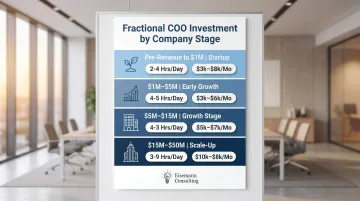
At the startup stage, a fractional COO typically focuses on foundational work — operational playbooks, core systems, and fundraising prep. By the $5M–$15M range, the scope shifts to embedded operational leadership: direct team accountability, cross-departmental coordination, and execution against growth targets.
Scale-ups at $15M–$50M often maintain the fractional model indefinitely. Enterprise-caliber operational leadership at a fraction of full-time cost is a hard arrangement to give up — even when the budget to hire full-time exists.
Key Factors That Affect Fractional COO Rates
Pricing is shaped by who you're hiring, what they're being hired to do, and the environment they're walking into.
Experience and Track Record
A COO with verifiable exits, Fortune 500 leadership, or a documented history of scaling companies to 8–9 figures commands higher rates. That premium is usually justified — experienced operators diagnose problems faster, execute solutions faster, and don't need a runway to get up to speed.
Years of experience alone isn't the metric — outcomes are. Look for candidates who can point to specific revenue impact, cost reductions, or operational transformations, not just tenure.
Scope and Complexity
The scope of work drives rate differences significantly. Higher-rate engagements typically involve:
- Cross-departmental coordination or company-wide transformation
- Direct team management responsibilities
- Executive-level strategic planning
Narrow, single-department work costs less and is a reasonable starting point if you're scoping a new engagement.
Industry Specialization
Niche sectors — healthcare, fintech, regulated industries, global operations — often require domain-specific knowledge. Specialists in these areas can command 15–25% premiums over generalist rates. Generalists cost less upfront but may take longer to ramp up in specialized environments, which has its own cost.
Geography and Remote vs. On-Site
Where your COO is based still influences pricing. Salary.com data shows full-time COO compensation averages $582,200 in San Francisco and $537,300 in New York — those figures set the floor for fractional rates in those markets. Remote work has reduced geography as a pricing driver, but on-site requirements add cost through travel and time commitment.
Engagement Duration
Longer commitments — typically 6–12 months — often come with more favorable effective rates than short-term or trial engagements. Most experienced fractional COOs require a minimum commitment of 3–6 months to ensure enough runway to actually move the needle.
Fractional COO vs. Full-Time COO: The Real Cost Comparison
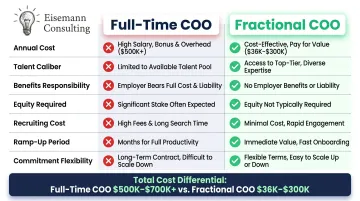
The sticker price of a fractional COO should always be evaluated against the true total cost of a full-time hire — not just base salary.
Full-Time COO: Total Employer Cost
Base salary is only the starting point. Here's what a full-time COO actually costs:
- Base salary: $390,000–$530,000 (25th–75th percentile per Salary.com 2026)
- Benefits: Add ~30% of base salary (BLS ECEC data, December 2025 shows benefits at 29.9% of total private industry compensation)
- Recruiting fees: Retained executive search typically runs 25–35% of first-year total compensation
- Bonuses: Variable, but commonly 20–40% of base at this level
- Equity: Expected for C-suite hires, carrying real dilution cost
- Ramp-up time: McKinsey research found 92% of external leaders take longer than 90 days to reach full productivity — meaning months of full salary with partial output
Realistically, a full-time COO costs $500,000–$700,000+ in the first year when all employer costs are included.
Fractional COO: Total Annual Cost
Annualized fractional spend across engagement levels typically runs $36,000–$300,000/year depending on hours needed and company stage. You're also not paying for:
- Benefits or employer payroll taxes
- Equity or dilution
- Executive search fees
- Severance risk
- 90-day ramp-up with no output
Side-by-Side Comparison
| Factor | Full-Time COO | Fractional COO |
|---|---|---|
| Annual cost | $500K–$700K+ (total employer) | $36K–$300K |
| Talent caliber accessible | Limited by salary budget | Enterprise-level expertise available |
| Benefits responsibility | Employer | None |
| Equity required | Yes | No |
| Recruiting cost | 25–35% of first-year comp | None |
| Ramp-up period | 3–6+ months | Faster; experienced operators ramp quickly |
| Commitment flexibility | Long-term employment | Flexible; exit without severance |
The Talent Access Advantage
Beyond cost savings, the fractional model gives growing companies access to operational leadership they couldn't realistically attract full-time. A $5M company can work with someone who has led operations at enterprise scale — expertise that typically requires a $600K+ package to attract.
That's the premise behind Eisemann Consulting. Julie Eisemann spent 26+ years in operational and global mobility leadership — including Amazon's global mobility program — and now works with mid-market companies and SMBs through fractional engagements. With $250M+ in documented cost savings across Fortune 500 and mid-market clients, her experience would be cost-prohibitive to hire full-time for most growing businesses.
Hidden Costs Most Business Owners Miss
Overage Rates and Scope Creep
Most retainers cap monthly hours. When scope expands — from process guidance to team management to technology oversight — overage hours are billed at a premium, and costs add up fast.
Ask upfront:
- How many hours are included in the retainer?
- How are additional hours billed?
- What counts as routine operational leadership vs. a special project?
Tool and System Costs
A fractional COO will often identify and implement new operational tools — and the licensing costs land on you, not them. Budget for software when evaluating total engagement cost.
Common tool categories to plan for:
- Project management platforms (Asana, Monday, ClickUp)
- OKR and goal-tracking software
- Automation and integration tools (Zapier, Make)
- Communication and documentation systems
Transition and Knowledge Transfer
If an engagement ends without proper documentation and handoff, the institutional knowledge walks out the door. Ask any fractional COO candidate:
- How do you document systems and processes during the engagement?
- What does your offboarding process look like?
- How do you build operational infrastructure that outlasts your involvement?
The best operators build systems designed to run without them — that's part of the value.
How to Estimate the Right Budget
Start With the Problem, Not the Price
Before looking at rate sheets, define what you actually need solved:
- Are you stuck in daily operational bottlenecks that prevent strategic work?
- Do you have team accountability gaps and no performance infrastructure?
- Are you implementing new systems with no one to own the process?
- Are you preparing to scale but lack the operational architecture to support it?
The nature of the problem determines the right engagement model. Project-based for defined deliverables. Retainer for ongoing operational leadership. Hourly for narrow advisory.
Calculate the Cost of Not Acting
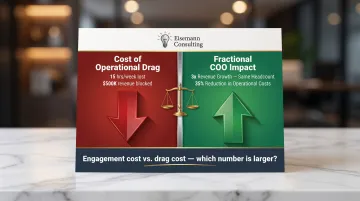
Founders often frame fractional COO cost as a line-item expense. Treat it as an investment with an expected return — and quantify what operational drag is already costing you.
Consider: if your operational inefficiencies are consuming 15 hours of your week, preventing you from closing $500K in new business, the cost of that drag likely exceeds a full-year fractional engagement. Eisemann Consulting's clients have experienced outcomes including a 3x revenue increase with the same operational headcount and 35% reduction in operational costs — results that make the engagement cost look like the smaller number in the equation.
Match Commitment Level to Readiness
Not ready to commit to a 6-month retainer? Start smaller:
- Project-based engagement for a defined initiative with clear deliverables
- Short-term advisory to evaluate fit before a longer commitment
- Free discovery work to see the approach in action before any financial commitment
Eisemann Consulting offers a free operational fix within 72 hours — a no-commitment entry point where Eisemann Consulting diagnoses and solves one operational bottleneck before you spend a dollar. Spots are limited to five businesses per month — so if the timing is right, it's worth claiming one.
When you do engage a fractional COO, look for transparent, upfront pricing with no hidden fees and flexible engagement terms — defined scope, measurable deliverables, and an exit path that doesn't require a negotiation if the fit isn't right.
Frequently Asked Questions
How much does a fractional COO charge?
Most fractional COO engagements run $3,000–$25,000+/month on retainer. The primary cost driver is hours needed per day, which scales with company stage and operational complexity — not company revenue alone.
How much does a fractional COO charge per hour?
Typical hourly rates range from $150–$500/hour, with most experienced operators falling in the $200–$375 range. Hourly billing suits short-term or narrow-scope work; ongoing operational leadership is more efficiently structured as a retainer.
What is a fractional COO salary?
Fractional COOs aren't salaried employees — they work as independent contractors or through consulting firms, billing via retainer, hourly, or project fees. For context, full-time COO base salaries average $466,700 per Salary.com (2026), not counting benefits, bonuses, and equity.
What does a fractional COO actually do?
A fractional COO translates CEO vision into operational execution: building accountability systems, managing teams, and putting the infrastructure in place to hit measurable outcomes. The result is an operator who owns the day-to-day so the CEO can focus on growth.
How many hours does a fractional COO work?
Typically 5–20 hours per week, structured as 1–4 hours per day depending on company stage. Advisory-only engagements run lighter (2–3 hours/week); growth-stage companies with complex operations may need 15–25 hours/week during intensive periods.
What is the difference between a fractional COO and a full-time COO?
A full-time COO is a permanent employee with salary, benefits, equity, and an employment commitment. A fractional COO works part-time across multiple clients and delivers comparable expertise at a fraction of the total cost, with no long-term employment risk and no equity dilution.