Introduction
There's a moment many mid-market founders recognize: the business has grown past the point where the founder can personally manage everything, but hiring a full-time COO at $300K+ in total compensation feels premature. Meanwhile, the operational weight keeps piling up — missed deadlines, broken processes, team confusion, and a calendar consumed by firefighting instead of growth.
A fractional operations consultant is a senior operations leader who embeds part-time in your business to repair broken processes, install missing systems, and build the operational infrastructure to scale — without the cost or commitment of a full-time executive hire.
Demand for this model has surged: according to Forbes, demand for fractional executives grew 46% year-over-year, and the share of executive positions mentioning fractional work has tripled since 2018.
This guide covers what the role actually involves, how it compares to alternatives, what to expect from an engagement, and how to hire the right person.
Key Takeaways
- A fractional operations consultant is a senior ops leader who embeds part-time to fix processes, build systems, and drive execution — not just produce recommendations.
- Cost: roughly 30–50% of a full-time COO's total compensation, with none of the long-term overhead.
- Best fit: mid-market companies ($3M–$50M revenue), Series A–C startups, and scale-ups that have outgrown their operational infrastructure.
- Measurable results include 45% faster cycle times, 60% fewer manual touchpoints, and 10–20 hours saved weekly.
What Is a Fractional Operations Consultant?
A fractional operations consultant is a seasoned operations leader who works with a company on a part-time, embedded basis — typically a set number of hours per week or days per month — rather than as a full-time hire.
This isn't a freelancer who delivers a report and moves on. A fractional consultant integrates into the leadership team, attends key meetings, owns accountability for outcomes, and stays engaged over time. The engagement is retained — not project-based.
Typical Engagement Parameters
| Parameter | Typical Range |
|---|---|
| Hours per week | 10–20 hours |
| Contract duration | 6–12 months |
| Concurrent clients | 2–4 |
| Scaling flexibility | Increases during launches, restructuring, or fundraising |
Who Is This For?
The model fits companies that have grown past startup chaos but aren't large enough to justify full-time C-suite leadership across every function. Based on the Umbrex Fractional Executive Playbook, the clearest fit is:
- Series A scale-ups ($3M–$15M ARR, 30–100 employees) that need repeatable operational cadences but can't yet justify a full-time COO
- Series B–C companies ($15M–$100M, 100–400 employees) focused on maintaining capital efficiency while scaling headcount
- Mid-market firms where revenue or team growth has outpaced the underlying infrastructure
The demand reflects a genuine structural shift in how growing companies build leadership capacity. The global fractional executive services market has topped $5.7 billion, growing at 14% annually. Gartner projects that 30%+ of midsize enterprises will have at least one fractional executive on retainer by 2027.
What Does a Fractional Operations Consultant Actually Do?
Core Operational Domains
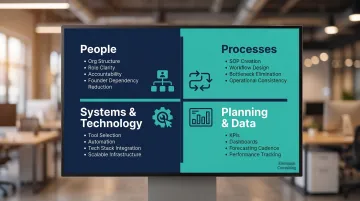
Most fractional ops engagements touch four pillars:
- People — org structure, role clarity, accountability frameworks, and reducing founder dependency
- Processes — workflow design, SOP creation, approval chain redesign, and bottleneck elimination
- Systems & Technology — tool selection, automation, and integration across the tech stack
- Planning & Data — KPI frameworks, performance dashboards, and forecasting cadence
Concrete deliverables a client should expect include workflow audits, documented SOPs, redesigned handoff processes, tech stack recommendations, and OKR or performance management frameworks. The emphasis is on hands-on execution — not slide decks.
AI-Powered Operations Work
Modern fractional operations consultants use low/no-code platforms to deliver faster, more durable results. Tools like Zapier, Airtable, and Retool enable workflow automation without large IT budgets or developer resources. Gartner projects 70% of new enterprise applications will use low-code or no-code technologies, with 50% of medium-to-large companies already adopting these platforms.
Firms like Eisemann Consulting combine AI-enabled automation with hands-on operational leadership to produce outcomes like 60% reduction in manual touchpoints and 45% faster cycle times. In one SaaS client engagement, implementing Zapier workflows connecting CRM, project management, accounting, and communication tools saved 18 hours per week in manual data entry and delivered $60K in annual operational savings.
Integration vs. Advisory
The stats above reflect a broader point: results depend on integration, not just advice. A fractional operations consultant doesn't hand off a deck and exit. During an engagement, they:
- Attend leadership team meetings and operational reviews
- Serve as a strategic sounding board for the CEO on operational decisions
- Take direct ownership of implementation milestones
- Build systems that function independently — so the business isn't dependent on their ongoing presence
What they don't own: Sales pipeline, financial fundraising, product roadmap, or legal/compliance decisions. The scope is strictly operational infrastructure: the systems, processes, and people structures that let every other function perform at full capacity.
Fractional Operations Consultant vs. Full-Time COO vs. Traditional Consultant
Side-by-Side Comparison
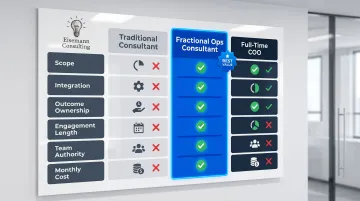
| Factor | Traditional Consultant | Fractional Ops Consultant | Full-Time COO |
|---|---|---|---|
| Scope | Narrow, diagnostic | Broad, execution-oriented | Full organizational scope |
| Integration | External | Embedded part-time | Internal executive |
| Outcome ownership | Delivers recommendations | Owns implementation | Owns operations fully |
| Engagement length | Project-based | 6–12+ months | Indefinite |
| Team authority | None | Advisory/collaborative | Direct management |
| Monthly cost | Variable (project) | $3,000–$15,000/month | $20,000–$37,000+/month |
The Cost Case for Fractional
Full-time COO total compensation runs $235,000–$440,000 per year according to Glassdoor data (base salary plus bonuses and equity). Add 20–30% employer-side overhead for benefits, payroll taxes, and related costs, and you're looking at $282,000–$572,000 fully loaded.
A fractional engagement — at roughly $3,000–$15,000/month depending on company size and scope — represents approximately 30–50% of full-time COO cost while delivering equivalent senior expertise. For companies where operational leadership needs are real but don't fill a full-time role, most companies at this stage save $150,000–$300,000 annually by going fractional.
When a Traditional Consultant Is the Right Call
There are situations where a project-based consultant is genuinely the better fit:
- You need a narrow, one-time diagnostic (a supply chain audit, a compliance review)
- Your internal team can own execution after the assessment is complete
- The engagement has a clear, finite deliverable and end date
The decision rule is simple: if you need answers, a consultant may be enough. If you need someone to own the fix, build the systems, and hold the team accountable over months — that's a fractional operations consultant.
Signs Your Business Needs a Fractional Operations Consultant
Three symptoms show up repeatedly in companies that are ready for this engagement:
1. The founder is the operational bottleneck. The CEO is deep in operational firefighting: solving process problems, making routine decisions, managing team escalations. Research from Harvard Business Review found CEOs spend approximately 70% of their time on internal activities.
When no one else has the authority or expertise to absorb that weight, the business grows only as fast as the founder can handle. That's a ceiling most founders hit faster than they expect.
2. Growth has outpaced infrastructure. The company is adding headcount, customers, or new markets faster than its systems can support. The warning signs are hard to miss:
- Fulfillment errors climbing as volume increases
- Inconsistent customer experience across teams or regions
- Communication breakdowns between departments
- Quality issues that are now reaching customers
Revenue or headcount growing 50%+ in 12 months without a corresponding leadership upgrade is a clear trigger. The business just needs infrastructure that matches its new size.
3. You've already had a consultant and nothing changed. The company hired someone, received a set of recommendations, and saw minimal follow-through. This isn't a diagnosis problem — it's an execution ownership problem. When the gap is in implementation rather than analysis, a fractional consultant who stays embedded and accountable is the right fit.
What to Expect from a Fractional Operations Consulting Engagement
Phase 1: Discovery and Audit (Weeks 1–4)
The engagement starts with a deep operational assessment: stakeholder interviews, process mapping, workflow audits, and identification of the highest-impact priorities. A well-run discovery phase delivers early clarity and quick wins within the first 30–60 days — building credibility before the heavier structural work begins.
Eisemann Consulting's Scalability Accelerator engagement, for example, opens with a full operational assessment and process mapping, then separates quick wins from longer-term priorities in a phased implementation plan.
Phase 2: Implementation — Months 2–6
This is the core of the engagement:
- SOP documentation and process redesign
- KPI frameworks and performance dashboards
- Technology deployment and workflow automation
- Team accountability systems and role clarity
- Regular check-ins with CEO and leadership team
Best practice: define 3–5 specific outcomes for the first 90 days with clear benchmarks at 30, 60, and 90-day marks — a useful structure whether you're buying or delivering these engagements.
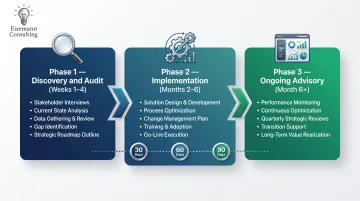
Phase 3: Ongoing Advisory — Months 6 and Beyond
As operational systems stabilize, the engagement shifts toward performance monitoring, iteration, and strategic advisory. This phase often includes preparing the organization to either hire a full-time operations leader or continue with fractional support at reduced hours.
Pricing Structure
Understanding the engagement shape makes the pricing easier to evaluate. Most fractional operations consultants use one of three models:
| Model | Typical Range | Best For |
|---|---|---|
| Monthly retainer | $3,000–$15,000/month | Ongoing embedded engagements |
| Project-based | $15,000 for 3 months (example) | Defined scope with clear deliverables |
| Hourly | $200–$500/hour | Targeted advisory or supplemental work |
Eisemann Consulting offers a low-commitment entry point worth noting: a free operational fix within 72 hours — one bottleneck diagnosed and resolved at no cost, limited to five businesses per month. It's a direct way to pressure-test the fit before any commitment — reach out to claim one of the five monthly spots.
How to Choose the Right Fractional Operations Consultant
Track Record Over Credentials
Formal certifications matter far less than evidence of implementation. Look for:
- Experience with companies at a similar stage and revenue range to yours
- A portfolio of 5–10 completed fractional engagements (not just advisory or interim roles)
- Documented outcomes: cost savings, cycle time reductions, efficiency gains — specific numbers
- References from companies that were in your position when they hired them
Most successful fractional executives bring 15+ years of senior operational leadership, often at enterprise or high-growth companies where they built the systems and skills they now deploy in fractional engagements.
Enterprise Expertise at a Fractional Price Point
One of the strongest arguments for fractional consulting is access to talent that would otherwise be out of reach. Julie Eisemann of Eisemann Consulting brings 26 years of operational and global mobility leadership to this model. Her work — trusted by Amazon and tied to over $250M in cost savings across Fortune 500 and mid-market clients — is now available to growing companies through project-based and fractional advisory engagements that don't require a full-time hire.

Knowing what that expertise looks like in practice makes the vetting process much more straightforward.
Green Flags and Red Flags
Hire when you see:
- Clear, upfront pricing and a defined onboarding process
- Willingness to define success metrics upfront
- References from similar-stage companies
- A specific methodology they can articulate for your challenges
- Trial period options (30–90 days) before a long-term commitment
Walk away if you see:
- Long-term contract lock-ins without performance benchmarks
- Vague deliverables or scope that can't be pinned down
- Heavy reliance on presentations with no implementation track record
- Promises of guaranteed results within unrealistic timeframes
- Inability to explain how they would approach your specific operational problems
Frequently Asked Questions
What does a fractional operations consultant do?
They embed part-time in your business to assess, redesign, and implement operational improvements across people, processes, and systems. Unlike a traditional consultant, they own outcomes — not just the analysis — and stay engaged through implementation.
How does a fractional operations consultant differ from a full-time COO or an external consultant?
A full-time COO holds internal authority; a traditional consultant delivers recommendations and exits. A fractional operations consultant sits in between — embedded, accountable, and execution-oriented, without the cost or employment commitment of a full-time hire.
How much does a fractional operations consultant charge?
Most engagements run on a monthly retainer of $3,000–$15,000 depending on company size and scope, or $200–$500/hour for targeted work. Project-based engagements (for defined scopes) are also common. These are practitioner-reported ranges — exact pricing varies by experience level, hours committed, and engagement complexity.
What is a fractional people operations consultant?
A specialized form of fractional consulting focused on the human side of operations: org design, role clarity, performance management, HR systems, and talent workflows. The focus is people infrastructure specifically, rather than the broader operational stack.
What qualifications does a fractional operations consultant need?
Most bring 15+ years of senior operational leadership, often at enterprise or high-growth companies, with a documented track record of driving measurable process improvements. Formal certifications matter far less than demonstrable results, client references, and evidence of completed fractional engagements rather than full-time roles.