Introduction
Picture this: you have a clear vision for where your company is headed. The market opportunity is real, your team is capable, and the ideas keep coming. But somehow, Monday morning still finds you buried in operational fires—resolving a conflict between sales and fulfillment, answering the same questions your team should be handling, and watching strategic priorities slip another week.
The problem isn't your vision—it's the gap between strategy and daily execution.
A fractional integrator is the operational counterpart that translates a founder's vision into daily, measurable progress—without the cost or commitment of a full-time executive hire.
According to a Forbes analysis of mid-market performance data, 73% of mid-market businesses failed to meet their growth expectations in 2025—not because they lacked strategy, but because operational breakdowns kept getting in the way.
This article covers what a fractional integrator is, why the visionary-integrator split matters, what the role looks like day-to-day, and how to know if your business needs one.
Key Takeaways
- A fractional integrator is a senior operations leader who executes a business owner's vision part-time or on retainer
- They bridge strategy and execution by building processes, aligning teams, and driving accountability
- Fits companies with 10–150 employees that have outgrown informal coordination but can't yet justify a full-time COO
- Monthly costs typically range from $3,000 to $15,000+, compared to $207K–$314K in total compensation for a full-time COO
What Is a Fractional Integrator?
The Integrator Concept
The term "integrator" comes from the Visionary/Integrator framework that Gino Wickman and Mark C. Winters popularized in Rocket Fuel (BenBella Books, 2015). In that framework, the Integrator is the operational executive who takes the Visionary's ideas and builds the systems, accountability structures, and execution discipline to make them real.
Per EOS Worldwide's own definition, the Integrator is "the tie-breaker for the Leadership Team, is the glue for the organization, holds everything together, beats the drum, is accountable for the P&L results, executes the business plan, and holds the Leadership Team accountable." Common titles include President, COO, or General Manager—the title is secondary to the function.
What Makes It "Fractional"
A fractional integrator performs this same function but on a part-time or interim basis—engaged for a set number of hours per week or month rather than as a full-time employee. This makes senior operational leadership accessible to companies that genuinely need it but can't justify (or afford) a six-figure executive salary.
The numbers back it up: fractional professionals in the U.S. roughly doubled from 60,000 in 2022 to 120,000 in 2024—a signal that more founders are choosing flexible executive access over full-time hires they're not yet ready to absorb.
Important Distinctions
That growth has also created some confusion about what a fractional integrator actually is—and isn't. Two distinctions that come up often:
- Fractional integrator vs. EOS® Implementer: An Implementer teaches the EOS® framework to an organization. The Integrator is the ongoing leadership role that runs within that structure. Different functions — and EOS companies typically need both at different stages.
- Fractional integrator vs. consultant: A traditional consultant advises from the outside and delivers recommendations. A fractional integrator operates inside the leadership team—attending meetings, owning execution outcomes, and managing priorities in real time. That embedded presence is what makes the function different.
The model also isn't limited to EOS® shops. If a founder is the ideas engine and the company keeps stalling on execution, that's the gap a fractional integrator is built to close—regardless of what framework (if any) the business runs on.
The Visionary-Integrator Dynamic: Why You Can't Do Both
Two Different Operating Modes
Most founders are natural Visionaries—wired for big-picture thinking, future strategy, and generating new ideas. The Integrator function requires the opposite orientation: detail, process, follow-through, and accountability. These aren't just different preferences—they're fundamentally different cognitive modes that compete for the same mental bandwidth.
Harvard Business Review research on why visionary leadership fails confirms the structural problem: visionary leadership consistently underperforms when it focuses on the "why" of change without adequately addressing the "how" of execution. Splitting these roles is a deliberate structural decision — one that high-performing organizations make on purpose.
What Happens When a Founder Tries to Do Both
The failure pattern is predictable:
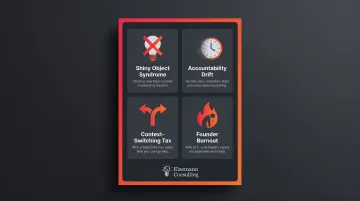
- Shiny object syndrome — New ideas continuously displace current priorities before they reach completion
- Accountability drift — Without a dedicated owner of follow-through, commitments made in meetings quietly expire
- Context-switching tax — APA research shows that even brief task switches can cost up to 40% of productive time
- Founder burnout — The 2024 Deloitte Well-being at Work Survey found that at least 40% of C-suite leaders report they "always" or "often" feel exhausted or stressed
When these consequences stack up, the natural instinct is to hand the problem to a capable internal hire. The risk: without real operational experience, someone promoted into an integrator-like role lacks the pattern recognition to build the systems needed to execute — they simply take ownership of the same dysfunction.
The Business Case for Separation
A dedicated integrator — fractional or full-time — frees the founder to focus on what actually moves the business: strategy, key relationships, and vision. Meanwhile, someone owns the execution side. That clarity of role is what turns a growth plan into a growth result.
What Does a Fractional Integrator Actually Do?
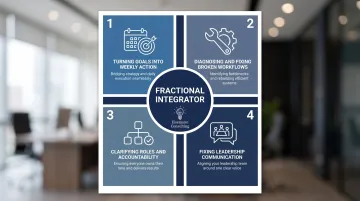
In practice, the role spans four functional areas—each one targeting a different place where growing businesses tend to lose momentum:
Turning Quarterly Goals Into Weekly Action
The integrator translates quarterly and annual goals into weekly actions. This means managing cross-departmental priorities, identifying what's blocking progress, and ensuring the leadership team is moving toward defined outcomes—not just staying busy with activity.
Diagnosing and Fixing Broken Workflows
Much of the work involves finding where the business loses time, money, or momentum due to undefined or broken workflows—then building systems to fix them. For practitioners like Julie Eisemann at Eisemann Consulting, this often includes AI-powered workflow automation alongside traditional process design. The goal is tools that eliminate manual work and create repeatable systems that hold up as the company scales.
Clarifying Roles and Building Accountability Cadence
The integrator works with department leaders to clarify roles, establish measurable KPIs, and create a consistent accountability cadence. Team members need to understand what "done" actually looks like on key initiatives—and that progress is tracked consistently.
Fixing How the Leadership Team Communicates
Operational dysfunction often shows up first in how a leadership team communicates. The integrator leads or facilitates regular meetings, ensures issues surface and get resolved systematically, and prevents the accumulation of unresolved problems that damage culture and slow execution.
Signs Your Business Needs a Fractional Integrator
Warning Signs to Watch For
Most founders recognize these symptoms before they name the cause:
- You're the only person who can resolve cross-functional conflicts
- Priorities shift week to week without clear resolution
- Team members don't know what "done" looks like on key initiatives
- Growth has stalled despite having capable people and solid ideas
- You're consistently pulled out of strategic work to fight operational fires
If three or more of these are familiar, the issue is almost certainly structural—not a personnel problem or a strategy problem.
The Right Company Stage
A fractional integrator delivers the highest return for companies with 10 to 150 employees that have outgrown informal coordination but aren't yet large enough to justify a full-time COO. Below 10 people, a founder can usually manage execution directly. Above 150, operational complexity typically warrants a dedicated full-time hire.
The fractional model also works well as a bridge for companies mid-search for a permanent COO. Instead of losing ground during a 3–6 month hiring process, a fractional engagement keeps execution on track—and often clarifies exactly what the full-time role requires.
Fractional Integrator vs. Full-Time COO: What's the Difference?
Terminology and Overlap
In practice, "fractional integrator" and "fractional COO" are used interchangeably by most providers. The integrator title is specific to the EOS® Visionary/Integrator model; "fractional COO" is the broader, framework-agnostic term for the same function. Both describe senior operational leadership on a part-time basis.
The Cost Comparison
The financial case is straightforward:
| Role | Typical Cost |
|---|---|
| Full-time COO (Glassdoor avg.) | ~$314,000/year |
| Full-time COO (BLS median, chief executives) | ~$206,000/year |
| Fractional integrator (coaching tier) | $1,000–$4,000/month |
| Fractional integrator (mid-level support) | $3,000–$6,500/month |
| Fractional integrator (full support) | $5,000–$15,000+/month |
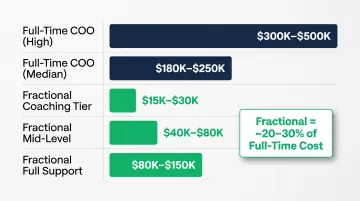
For companies under $20M in revenue, a fractional engagement typically delivers the operational leadership they need at roughly 20–30% of the full-time cost. Hourly rates for fractional COOs generally run $150–$500/hour, with most experienced professionals in the $200–$350 range.
Engagements commonly run 6 months to 2 years, with most structured as monthly retainers with 30-day termination flexibility.
When to Transition to a Full-Time Hire
The fractional model isn't permanent by design. Part-time coverage eventually becomes insufficient as the organization scales. Common signals that it's time to convert to a full-time hire include:
- Headcount exceeds 50–75 and cross-functional coordination demands daily attention
- The fractional leader is consistently logging near full-time hours
- Revenue growth has introduced compliance, reporting, or audit complexity requiring constant oversight
- The business is preparing for a funding round, acquisition, or major market expansion
A well-run fractional engagement is also the most practical way to define exactly what a full-time COO role should look like — scope, skills, and all — before writing the job description.
Frequently Asked Questions
What is the difference between a COO and an integrator?
A COO is a broad executive role covering all operational functions across a company. The Integrator is a specific role within the EOS® framework focused on executing the Visionary's strategy and holding the leadership team accountable. In practice, many COOs—full-time or fractional—serve the integrator function whether or not their company runs EOS®.
What is the difference between a fractional COO and a full-time COO?
A fractional COO provides the same senior operational leadership as a full-time COO but works part-time or on retainer. This makes the role financially accessible to growing companies that need the function but can't yet justify the full-time salary, benefits, and overhead.
What does a fractional COO actually do?
Core responsibilities include:
- Translating strategy into execution
- Designing and optimizing operational processes
- Aligning teams around priorities and KPIs
- Driving cross-functional accountability through consistent meeting cadences
How much does a fractional COO cost?
Industry-reported ranges run from $1,000–$4,000/month for coaching-level support to $5,000–$15,000+/month for full integrator engagement, with hourly rates between $150 and $500. Costs vary based on hours engaged, company complexity, and the executive's experience level.
How many hours does a fractional COO work?
Engagements are flexible—typically ranging from a few hours per week at the coaching tier to roughly one full day per week at full support level. Hours can scale up or down as the company's needs evolve.