That's where the fractional CFO model fills a genuine gap.
A fractional CFO is an experienced Chief Financial Officer who provides strategic financial leadership on a part-time, retainer, or project basis. "Fractional" refers to the time commitment, not the quality of expertise. You're getting the same strategic caliber — forecasting, capital planning, investor-readiness — without the fixed cost of a permanent executive.
This article covers what a fractional CFO actually does, how they differ from full-time and interim CFOs, the key benefits, when the timing makes sense, and what a real engagement looks like from day one.
TL;DR: Key Takeaways
- A fractional CFO delivers executive-level financial strategy on a part-time basis — without the cost of a permanent hire
- Core work includes financial forecasting, cash flow management, fundraising support, and strategic planning
- Companies in growth, fundraising, or turnaround phases benefit most
- Monthly retainers typically run $3,000–$15,000+ depending on scope and company size
- They work alongside your existing accounting team, complementing (not replacing) the people already in place
Fractional CFO vs. Full-Time CFO vs. Interim CFO
These three roles serve different needs at different points in a company's life — and choosing the wrong one is an expensive mistake.
Full-time CFO: Best suited for companies where financial complexity has outgrown part-time oversight — typically $15M–$20M+ in revenue for tech companies and $10M–$30M ARR for SaaS. At that scale, the salary, equity, and benefits package becomes justifiable.
Interim CFO: A full-time professional brought in temporarily during a departure, leave of absence, or major transition. Engagements have a defined end date; the focus is continuity, not long-term strategy.
Fractional CFO: Works part-time across one or more companies on a retainer or project basis. The engagement is goal-driven — specific financial outcomes, not day-to-day operational maintenance.
| Full-Time CFO | Interim CFO | Fractional CFO | |
|---|---|---|---|
| Time Commitment | 40+ hrs/week | 40+ hrs/week (temp) | Under 20 hrs/week |
| Duration | Permanent | Months to 1 year | Ongoing, open-ended |
| Cost | Salary + equity + benefits | Monthly rate | Retainer or hourly |
| Best For | Sustained complexity at scale | Leadership gap or transition | Growth stage, cost optimization |
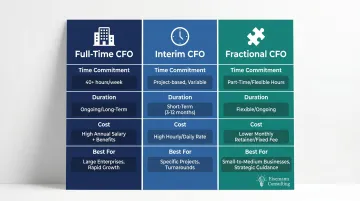
Beyond the cost differences shown above, the fractional model reduces a risk the table doesn't capture: executive failure. Spencer Stuart research estimates 30% of new C-suite executives fail within their first 18 months. Paired with a $350,000+ compensation commitment, that's a costly gamble. Fractional engagements carry no such exposure — if the fit isn't right, the arrangement ends without the financial fallout of a full executive departure.
What Does a Fractional CFO Do?
Strategic Financial Planning and Forecasting
A fractional CFO builds financial models across multiple time horizons: 90-day operational forecasts, annual budgets, and 3–5 year strategic plans. They track variances against targets, establish KPIs, and keep financial performance aligned with business goals.
This is fundamentally different from what an accountant or bookkeeper does. Accounting looks backward — recording what happened. A fractional CFO looks forward, modeling what's likely to happen and what decisions will change that trajectory.
Cash Flow Management
Cash flow problems are the most common reason fractional CFO engagements start. A 2025 QuickBooks survey found that 43% of small business owners cite cash flow as a problem, with 74% saying it has worsened or stayed the same year over year.
Fractional CFOs address this by implementing rolling 13-week cash flow forecasts — giving leadership visibility into shortfalls before they become crises. They enforce collection discipline, model the cash demands of growth (hiring, inventory, expansion), and help fast-growing companies avoid the trap of scaling revenue while running out of runway.
Fundraising and Capital Strategy
When a company raises equity or debt, the CFO role becomes critical. Fractional CFOs:
- Build investor-ready financial models and projections
- Support pitch deck development with defensible numbers
- Manage due diligence requests and data room preparation
- Evaluate deal terms — equity dilution, debt covenants, valuation mechanics
Early capital decisions have long-term consequences. An experienced fractional CFO protects shareholder value by ensuring founders understand exactly what they're agreeing to.
Financial Systems, KPIs, and Reporting Infrastructure
Many growing companies reach a point where their financial data lives across five different platforms and nobody trusts any of them. A fractional CFO audits existing tools, identifies gaps, and implements integrated reporting systems that surface real-time performance data.
Modern fractional CFOs increasingly use AI-driven analytics and automation to accelerate forecasting accuracy. According to a 2025 Gartner survey, 59% of finance functions now use AI — up from 37% just two years prior. That shift makes clean, consolidated financial data a foundational requirement, not an afterthought.
M&A, Exit Planning, and Turnaround Support
Some of the highest-value fractional CFO work is project-based:
- Acquisitions: Diligence, deal structuring, and post-close integration planning
- Exit preparation: Building the data room, normalizing earnings, and fielding buyer Q&A
- Turnarounds: Identifying cost cuts, preserving cash, and negotiating with creditors
In each case, the engagement is time-bound and targeted. You get senior financial judgment exactly when the stakes are highest, without adding a permanent executive to the payroll.
Key Benefits of Hiring a Fractional CFO
Cost Savings Without Sacrificing Expertise
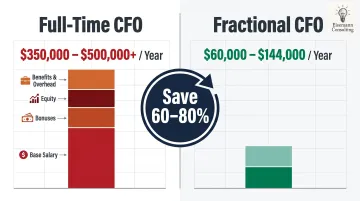
The numbers are straightforward. A mid-market CFO at a $10M–$50M company commands $150,000–$250,000 in base salary, with total compensation (bonuses, equity, benefits) reaching $350,000–$500,000+ annually. A fractional engagement at the same revenue stage typically runs $5,000–$12,000/month — roughly $60,000–$144,000 per year.
That's a 60–80% cost reduction for the same caliber of strategic guidance.
Access to Enterprise-Level Experience
Cost savings alone don't tell the whole story. Fractional CFOs typically bring cross-industry backgrounds that most mid-market companies couldn't access through a single hire. They've seen how a $200M company structures its reporting, how a Series B fundraise gets documented, how a distressed business cuts costs without breaking operations.
That breadth matters. Insiders who've only ever worked in one company or industry often don't know what "good" looks like at the next stage.
Flexibility to Scale Up or Down
Fractional engagements flex with your needs:
- Scale up during fundraising, M&A, or rapid expansion
- Scale back during stable operating periods
- End cleanly when the company grows into a full-time hire
There's no severance, no long-term contract, and no complicated exit when the time comes to transition to a full-time hire.
Objective Outside Perspective
Internal teams have blind spots — they're embedded in the culture, the politics, and the history. A fractional CFO has no stake in protecting existing decisions. They ask hard questions, challenge assumptions, and recommend changes that internal hires might avoid raising.
The result: faster alignment on what's actually true versus what the team has always assumed.
Faster Impact Than a Full-Time Hire
A fractional CFO can begin delivering value in weeks — assessing cash flow risks, identifying reporting gaps, and prioritizing immediate actions. A permanent executive hire, by contrast, typically needs 3+ months before they're fully productive in a new organization. With a fractional model, the ramp-up is your diagnostic period, not their orientation.
When Does a Business Need a Fractional CFO?
Revenue and Complexity Triggers
Companies in the $2M–$50M revenue range typically benefit most. Below $2M, a strong bookkeeper or accountant usually covers what's needed. Above $50M with sustained complexity, a full-time hire often becomes justified.
Key warning signs that fractional CFO support is overdue:
- Cash flow is unpredictable or frequently tight
- No forward-looking financial model exists — decisions are reactive
- The founder is still making all financial calls without a structured process
- Investors or lenders are asking for reporting the company can't produce
- The business is growing but profitability isn't improving
Growth and Critical Event Triggers
Certain moments demand CFO-level thinking regardless of company size:
- Fundraising rounds (Series A, B, C, or debt facilities)
- Rapid expansion — new markets, product lines, or managing multiple business entities
- M&A activity on either side of a transaction
- Audit preparation, especially if it's the company's first
- Financial turnaround when runway is shrinking and hard decisions can't wait
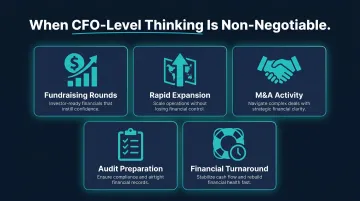
Getting these moments wrong — a mispriced raise, a botched audit, a cash crisis without a plan — carries consequences that outlast the event itself.
When You May Not Need One Yet
Very early-stage companies — pre-revenue or with simple, single-entity financials — typically need a bookkeeper or accountant, not a CFO. That changes once decisions require financial modeling, scenario planning, or external accountability to investors and lenders. If the work is still just recording what happened, fractional CFO support isn't the right fit yet.
What to Expect: Engagement, Cost, and Getting Started
How the Engagement Works
A typical fractional CFO engagement begins with a financial diagnostic: an assessment of current reporting, cash position, model accuracy, and gaps. From there, priorities are established: which problems get addressed first, what KPIs get tracked, and what the reporting cadence looks like with leadership.
Ongoing engagements usually involve weekly or bi-weekly leadership meetings, with additional hours for project work. The fractional CFO integrates with your existing team, working above your bookkeepers and accountants in a strategic capacity, not replacing them.
Typical Pricing Models
Three pricing structures are common:
- Monthly retainer — most common for ongoing strategy; typically $5,000–$12,000/month for companies in the $5M–$25M range, rising to $15,000+ for more complex engagements
- Hourly — suited for defined projects; rates generally run $175–$450/hour depending on seniority and scope
- Project-based — used for M&A diligence ($15,000–$35,000), fundraise preparation ($5,000–$20,000), or financial model builds ($10,000–$25,000)
Even at the higher end, these figures remain significantly below the total compensation cost of a permanent hire.
Maximizing ROI From the Engagement
A fractional CFO's output is only as good as the operational inputs feeding it. Companies that extract the most value share one trait: clean, reliable data and efficient cross-functional workflows.
When those conditions don't exist, the CFO ends up fixing infrastructure instead of driving strategy. Common bottlenecks include:
- Manual, error-prone reporting processes
- Financial data siloed across disconnected systems
- Undocumented workflows that create inconsistency
Addressing these issues before or alongside a CFO engagement significantly shortens the ramp time. Operational consulting firms like Eisemann Consulting offer targeted engagements, such as KPI dashboard builds and automated data workflows, that create the reporting foundation a fractional CFO needs to work effectively from the start.
What to Look for When Evaluating Candidates
- Relevant industry experience — not just finance generalists
- Track record with companies at your specific stage (pre-Series A, scaling, turnaround)
- Familiarity with modern financial tools and AI-powered forecasting
- Strong communication skills — they need to translate numbers into decisions for non-finance leadership
- References from engagements with measurable outcomes
Ask candidates directly: what did cash flow look like at the beginning of your last engagement versus the end? What financial decisions did you help a client avoid?
Frequently Asked Questions
What is a fractional chief financial officer?
A fractional CFO is an experienced financial executive engaged part-time or on contract to provide strategic financial leadership — including forecasting, cash flow management, and capital planning — without the cost or commitment of a full-time hire. The arrangement is flexible by design, but the financial expertise is fully enterprise-grade.
What is the salary of a fractional chief financial officer?
Fractional CFOs aren't salaried employees. They're typically paid via monthly retainer ($3,000–$20,000+ depending on scope), hourly rates ($175–$450/hour), or project fees — considerably more cost-effective than a full-time CFO earning $200,000–$400,000+ in base salary alone.
How is a fractional CFO different from an interim CFO?
An interim CFO is a full-time, temporary replacement during a leadership transition — filling a vacancy. A fractional CFO is a part-time strategic partner for companies that don't need (or can't justify) a full-time executive. They serve distinct needs and aren't interchangeable.
When should a small business hire a fractional CFO?
Common triggers include:
- Revenues reaching $2M+ with increasing financial complexity
- Preparing for a fundraising round or significant expansion
- Struggling with cash flow visibility or lacking reliable financial models
If you're making major financial decisions without a model, that's usually the clearest signal.
What should I expect in the first 90 days with a fractional CFO?
Expect a financial diagnostic, identification of immediate priorities, cash flow forecast repair or build-out, and establishment of KPI reporting with leadership. Most engagements surface actionable insights within the first few weeks — not months.
Can a fractional CFO work alongside my existing accounting team?
Yes — that's the design. A fractional CFO sits above your bookkeepers and accountants in an advisory role, providing forward-looking financial leadership that operational accounting staff don't typically handle. They direct the team; they don't replace it.