That's not a strategy problem. It's an operations problem.
A fractional COO gives you senior operational leadership — part-time, without the full-time price tag. This guide covers exactly what a fractional COO is, the signals that tell you it's time to hire one, what they actually do day-to-day, and the six factors that separate the right hire from an expensive mistake.
Key Takeaways
- A fractional COO embeds part-time into your business to provide the same operational leadership as a full-time hire
- Most entrepreneurs benefit when revenue is $1M–$10M and the founder has become the operational bottleneck
- Core work covers process optimization, team accountability, and turning founder vision into day-to-day execution
- Costs typically run $5,000–$15,000/month on retainer — versus $250,000–$550,000/year for a full-time COO
- When hiring, prioritize stage-relevant experience, hands-on execution style, and cultural fit over résumé credentials
What Is a Fractional COO?
A fractional COO is an experienced Chief Operating Officer who works with your company on a part-time or project basis — 15–30 hours per month for standard retainer engagements — embedding into your leadership team to provide the same strategic and operational ownership as a full-time hire, with the flexibility to scale involvement up or down.
The distinction from a consultant matters. As ScaleUpExec describes it: "A consultant diagnoses problems and delivers recommendations. A fractional COO diagnoses problems, takes ownership of the solutions, and executes alongside your team." They lead people, hold teams accountable, and own outcomes through to execution.
Fractional COO vs. Full-Time COO
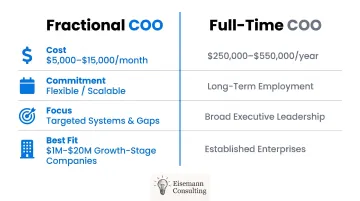
| Dimension | Fractional COO | Full-Time COO |
|---|---|---|
| Cost | $5,000–$15,000/month | $250,000–$550,000/year total comp |
| Commitment | Flexible; scale up or down | Long-term employment |
| Focus | Targeted systems and execution gaps | Broad executive leadership |
| Best fit | Growth-stage companies ($1M–$20M) | Established enterprises with complex infrastructure |
Who Benefits Most?
Growth-stage companies in the $1M–$20M revenue range are the clearest fit — past the point where a founder can run everything solo, but not yet scaled enough to justify a full-time C-suite hire. Strong candidates also include:
- Hypergrowth companies outpacing their operational infrastructure
- Companies preparing for M&A, investor onboarding, or due diligence
- Businesses navigating a leadership transition or interim gap
- Founders who want to stay focused on product and growth, not daily firefighting
Signs You Need a Fractional COO
Most founders hit a wall somewhere between $1M and $5M in revenue — the point where the business has outgrown what one person can run. Decisions queue up waiting for your approval. Projects that should take two weeks take two months. Good people on your team can't move forward without you.
According to a Salesforce/Slack study, small business owners lose an average of 96 minutes of productivity daily — roughly three weeks of lost time per year — to operational inefficiency. That cost compounds fast when you're also the acting COO by default.
Check these signals against your current situation:
- Revenue is consistent ($1M–$10M) but growth feels operationally stuck
- You spend most of your week firefighting rather than building
- Your team has tools and systems, but nobody follows through consistently
- You're preparing to raise capital, pursue acquisition, or onboard investors
- You've felt the early signs of founder burnout — the Balderton Capital Founder Wellbeing Report found 72% of founders report burnout as a significant problem, with 91% experiencing deterioration in personal wellbeing
- Nothing gets done unless you're personally involved
None of these are failure signals. They're growth signals. What's missing is dedicated operational leadership — someone accountable for execution, not just strategy — so you can stop being the bottleneck and start running the business you built.
What a Fractional COO Actually Does
A fractional COO is an execution partner — not a consultant who hands you a report and disappears. They embed into your business, take direct ownership of operational outcomes, and drive follow-through on the things that actually move the company forward.
Core Responsibilities
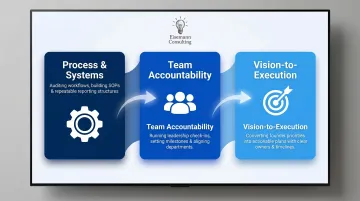
Most fractional COO engagements center on three areas:
- Process and systems work — Auditing current workflows, identifying where things break down, and building repeatable SOPs and reporting structures that outlast the engagement
- Team accountability — Running leadership check-ins, setting measurable milestones, and keeping departments aligned so the founder isn't the only one who can answer "where are we on this?"
- Vision-to-execution translation — Converting the founder's priorities into actionable plans with clear owners, defined timelines, and managed follow-through
Types of Engagements
Three models cover most situations:
| Engagement Type | Best For | Structure |
|---|---|---|
| Project-based (3–12 months) | Specific initiatives: audits, ERP rollouts, scaling prep | Fixed scope and timeline |
| Ongoing retainer | Steady-growth companies needing standing operational leadership | Monthly advisory and oversight |
| Interim/hybrid | Leadership gaps or rapid growth spikes | Near-full-time, then scales back once stabilized |
How to Hire the Right Fractional COO: 6 Key Factors
The fractional COO market has grown fast — the global fractional executive market hit an estimated $5.7 billion in 2024, with professionals in the category doubling from 60,000 to 120,000 between 2022 and 2024. More options mean more noise. These six factors help you connect your actual needs to the right candidate.
Factor 1: Stage-Relevant Experience
This is the most important filter. A COO who's built operations at a 500-person company has a completely different toolkit than one who specializes in getting businesses from $1M to $10M. The methodologies, team structures, and execution priorities are worlds apart.
Ask for specific examples — anonymized is fine — of companies at a similar revenue stage and growth phase they've worked with. General credentials don't tell you much. Case studies do.
Factor 2: Industry and Operational Context
A fractional COO familiar with your industry's compliance landscape, vendor relationships, or hiring dynamics can diagnose problems faster and implement solutions with less friction.
That said, strong systems thinkers from adjacent industries often bring fresh cross-industry perspective. Don't disqualify someone just because they haven't worked in your exact sector.
Factor 3: Execution Approach, Not Just Advisory
This is where many hires go wrong. There's a meaningful difference between a fractional COO who builds SOPs, runs team meetings, owns accountability, and pushes implementation — versus one who provides a strategic roadmap and expects your team to execute it.
Watch for this phrase in discovery calls: "I'll provide the roadmap and your team can execute." That's a consultant, not an embedded operational leader. Entrepreneurs need someone doing the work alongside them, not observing from outside.
Factor 4: AI-Enabled Workflows and Modern Tooling
In 2026, a fractional COO who uses AI-powered automation and low/no-code tools can deliver results faster than one relying on traditional methods. Platforms like Zapier, Airtable, and Retool allow rapid workflow automation without requiring engineering resources.
Eisemann Consulting's AI-enabled, human-led approach illustrates what this looks like in practice: combining automation tools with hands-on execution to drive a 60% reduction in manual touchpoints and 45% faster cycle times for clients.
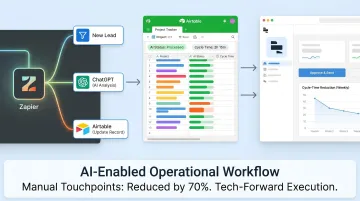
When evaluating candidates, ask specifically how they use automation tools to accelerate their work — not just as a theoretical concept, but in their actual engagements.
Factor 5: Cultural Alignment with the Founder's Style
Entrepreneurial businesses move fast, run informally, and are deeply shaped by the founder's personality. A fractional COO who arrives with rigid corporate process frameworks can slow execution and damage team morale before they've fixed anything.
Look for candidates who describe adapting their systems to fit the company's energy rather than replacing it. Previous experience with founder-led businesses matters here, because it signals they understand how founder-led teams actually operate.
Factor 6: Engagement Flexibility and Transparent Pricing
A healthy engagement structure includes:
- A defined onboarding period (30–60–90 day ramp with clear milestones)
- Transparent pricing with no hidden fees — either monthly retainer or project-based
- The ability to scale hours up or down as business needs shift
- No long lock-in contracts requiring commitment before demonstrated value
Any arrangement that can't define what success looks like at 90 days is worth scrutinizing.
How Eisemann Consulting Can Help
Eisemann Consulting is a McKinney-based operational leadership firm founded by Julie Eisemann, who brings 26+ years of global mobility and operations experience — Amazon included — to mid-market and fast-growing companies that need Fortune 500-caliber execution without Fortune 500 price tags.
Her approach is AI-enabled and hands-on. Using Zapier, Airtable, Retool, Sintra, and Base44, she builds operational systems that cut manual work and accelerate cycle times — contributing to $250M+ in cost savings across Fortune 500 and mid-market clients throughout her career.
Engagements come with:
- No long-term contracts
- Transparent, upfront pricing
- A defined scope and measurable outcomes from day one
For entrepreneurs who aren't ready to commit, Eisemann Consulting offers a free operational fix within 72 hours — a hands-on solution to one specific bottleneck, no commitment required.
If you're scaling, preparing for global growth, or simply spending too much time in the weeds, a no-obligation consultation can identify exactly where fractional operational support would have the fastest impact. Reach out at julie@eisemannconsulting.com to get started.
Frequently Asked Questions
Frequently Asked Questions
What does a fractional COO do for an entrepreneur?
A fractional COO embeds part-time into your business to handle operational execution: building systems, aligning teams, and clearing bottlenecks so you can focus on growth instead of reacting to daily operational issues. Unlike a consultant, they own outcomes and drive implementation alongside your team.
How much does a fractional COO cost in 2026?
Monthly retainers typically run $5,000–$15,000/month depending on scope and hours, while hourly engagements range from $150–$500/hour. Fixed-fee projects can run $25,000–$150,000+. All of these are significantly less than a full-time COO's total compensation of $250,000–$550,000/year.
How is a fractional COO different from a business consultant?
A consultant typically advises, delivers recommendations, and exits. A fractional COO embeds in the business, leads the team, sets priorities, and is directly accountable for execution outcomes. The distinction is accountability: they're responsible for whether things actually get done.
When is the right time to hire a fractional COO?
The right time is when you've become the operational bottleneck — revenue is consistent ($1M–$10M) but growth feels stalled, your team can't execute without you, and the business needs more structure and accountability than the current team can provide.
How long does a fractional COO engagement typically last?
Most engagements run 6–18 months, with project-based work completing in 3–6 months and ongoing advisory partnerships sometimes continuing for years. Many companies use a 30–90 day pilot to assess fit before committing to a longer engagement.
What should I look for when hiring a fractional COO?
Prioritize experience at a similar growth stage, a hands-on execution approach (not just advisory), cultural compatibility with your founder-led environment, and modern operational methods — including AI and automation tools. Ask for specific case studies, not just credentials.