This is exactly the problem a small business operations consultant is built to solve. Not a high-level strategist who leaves behind a slide deck—a practitioner who maps how your business actually runs, finds what's slowing it down, and builds practical systems to fix it.
This article covers what operations consultants do, what results to expect, when the right time to hire one is, and how to choose someone who'll actually deliver.
Key Takeaways
- Operations consultants analyze workflows, eliminate inefficiencies, and build repeatable systems so the business runs without the founder making every call
- Core services include process analysis, workflow automation, team structure clarity, performance tracking, and documentation
- Businesses typically see reduced costs, faster cycle times, and fewer manual bottlenecks after engagement
- The right time to hire is when the same problems keep resurfacing, growth is creating chaos, or the founder is the bottleneck
- Look for consultants who've actually implemented—not just advised—and who have worked with businesses at your stage
What Is a Small Business Operations Consultant?
An operations consultant focuses on your company's internal mechanics—workflows, systems, team structure, and daily processes—rather than broad market strategy. Where a general business advisor might recommend entering a new market or repositioning your brand, an operations consultant asks: how does work actually get done here, and what's breaking?
That distinction matters because strategy without operational capability doesn't scale. The job is execution-focused: diagnose what's inefficient, then fix it.
Two Engagement Models Worth Understanding
When evaluating consultants, you'll encounter two approaches:
- Assessment-only: Audit plus a recommendations report — you own the implementation from there.
- Hands-on implementation: The consultant embeds with your team, builds the actual systems, and trains your team on adoption.
For smaller organizations without experienced process managers on staff, assessment-only engagements rarely drive meaningful change. A report sits in a drawer. Implemented systems actually run. Eisemann Consulting, for instance, offers a free 72-hour operational fix that delivers a working improvement rather than a recommendations deck — a practical illustration of how hands-on engagement differs from advisory-only work.
What Does a Small Business Operations Consultant Do?
Analyzes and Redesigns Business Processes
Every engagement starts with understanding your current value chain—the sequence of activities that produce results for customers. A consultant maps this end-to-end, using frameworks like Lean or Six Sigma to surface bottlenecks, redundant steps, and gaps.
The goal is twofold: being more effective (doing the right things) and more efficient (doing them with less time and cost). These aren't always the same fix — a process can be fast but producing the wrong output, or correct but burning unnecessary time at every step.
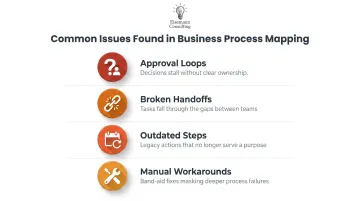
What that mapping typically uncovers:
- Approval loops with no clear owner
- Handoffs that rely on memory or email chains
- Steps that exist because "we've always done it that way"
- Manual workarounds for tools that should talk to each other
Optimizes Workflows and Automates Repetitive Tasks
A 2024 Slack survey of 2,000 U.S. small business owners found the average owner loses 96 minutes per day to wasted or inefficient work—roughly three weeks per year. That's time that could be redirected toward growth.
Operations consultants map workflows to identify where tasks get stuck, where handoffs fail, and where manual work is draining capacity. Modern consultants—particularly those working with low/no-code tools—can then automate the repetitive work entirely.
Common automation targets include:
- Data entry and syncing across disconnected systems
- Lead follow-up sequences and CRM updates
- Invoice generation and billing workflows
- Document routing and approvals
- Internal notifications and status updates
Eisemann Consulting's tool stack for these projects includes Zapier, Airtable, Retool, Make, and AI platforms like Sintra and Base44. In one documented engagement, connecting a SaaS company's CRM, project management, accounting, and communication tools via Zapier eliminated 18 hours of manual data entry per week and cut data errors by 95%—delivering $60,000 in annual operational savings.
Clarifies Team Structure and Roles
Role confusion is one of the most expensive problems in growing businesses—and one of the most invisible. According to Gallup's 2025 data, only 46% of U.S. employees strongly agree they know what's expected of them, down from 56% in 2020. When ownership is unclear, decisions stall, errors multiply, and leadership gets pulled into work it shouldn't be doing.
An operations consultant addresses this by:
- Defining clear ownership for every recurring function
- Building org structures that match the company's actual strategy
- Creating accountability frameworks that scale as the business grows
Implements Performance Tracking Systems
Gut-feel management works when a business is small enough for one person to see everything. Past that point, you need data — not spreadsheets pulled weekly, but dashboards owners can check without waiting for a Friday report.
Operations consultants set up KPIs tied to the processes that matter most. Metrics typically tracked include fulfillment speed, customer service response time, team output rates, and cost per process step. The Eisemann Consulting Scalability Accelerator package includes KPI dashboards as a core deliverable, built in tools like Retool for immediate, accessible visibility.
Builds Documentation and Scalable Operating Models
At some point, every fast-growing business hits the same wall: a new hire starts, and there's nothing written down for them to follow. The founder re-enters execution mode. The team slows down. Operations consultants break that cycle before it repeats.
Operations consultants create:
- SOPs for repeatable processes
- Playbooks for common decisions and exceptions
- Workflow guides that make onboarding faster and handoffs reliable
The goal is removing the founder as the single point of failure—without losing quality or control.
Benefits of Hiring an Operations Consultant
Reduced Costs and Improved Efficiency
Consultants identify waste that internal teams have normalized. Common culprits include:
- Redundant steps no one questions anymore
- Manual processes that automation could handle
- Technology gaps causing duplicate work across systems
McKinsey's research estimates activities accounting for up to 30% of U.S. work hours could be automated by 2030—most of that opportunity is sitting in businesses right now, unaddressed.
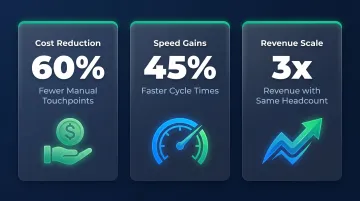
For Eisemann Consulting clients, documented results include a 60% reduction in manual touchpoints and 45% faster cycle times through workflow redesign.
Scalable Systems That Support Growth
Well-designed operational systems let you increase revenue without proportionally increasing overhead. Serving more customers, onboarding more staff, and entering new markets stops requiring you to rebuild from scratch each time. One Eisemann Consulting client—a mid-market e-commerce company—achieved 3x revenue growth with the same operational headcount after a workflow redesign that cut order fulfillment from five days to one.
Stronger Team Performance and Alignment
When roles are defined and processes are documented, teams operate with less confusion, fewer escalations, and more ownership of outcomes. Role clarity has a direct impact on engagement too—Gallup's research ties it to retention and performance, and low engagement costs the global economy an estimated $8.8 trillion annually in lost productivity.
An Outside-In Perspective
Internal teams are often too close to their own processes to see what's broken. Consultants aren't tied to internal politics, legacy habits, or departmental loyalties—which means they can diagnose problems insiders rationalize, miss, or have simply stopped seeing.
They also bring proven approaches from comparable organizations: the workflow fix that worked in one mid-market logistics company often applies directly to another in professional services.
When to Hire a Small Business Operations Consultant
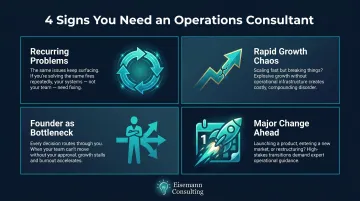
When the same problems keep resurfacing. If your team is constantly firefighting the same failures—delayed deliverables, communication breakdowns, recurring errors—that's a systemic issue, not bad luck. A consultant diagnoses root causes instead of treating symptoms repeatedly.
When rapid growth is creating chaos. Scaling without operational infrastructure causes things to break: new hires don't know processes, and leadership gets pulled into day-to-day execution instead of strategy. Getting systems in place before the cracks widen is far cheaper than rebuilding mid-scale.
When the owner is the bottleneck. If every decision, approval, or exception routes through the founder, the business can only grow as fast as one person can think. Building delegation frameworks and documented systems removes this constraint—without sacrificing control.
When a major change is on the horizon. Product launches, new market entry, a significant hiring push, or a technology overhaul all carry operational risk. Bringing a consultant in before the change dramatically improves execution success. That's also the moment a structured operational diagnostic pays off most — catching hidden blockers before they turn into costly rollout failures. Eisemann Consulting's free 72-hour diagnostic is designed exactly for this window.
How to Choose the Right Operations Consultant
Prioritize Implementation Experience
A consultant who only delivers reports is very different from one who builds the actual systems. For small and mid-market companies, implementation capability matters far more than credentials. Ask directly: do you deliver recommendations, or do you build and implement?
Look for evidence of hands-on work—not just strategy frameworks, but actual systems built for businesses similar to yours.
Evaluate Methodology and Relevant Experience
Ask how they diagnose operational problems and what frameworks they use. Relevant questions:
- What does your assessment process look like?
- What tools do you use for workflow automation?
- Can you share examples from businesses at my stage and size?
Experience at your company's size and growth stage matters more than industry-specific knowledge. Workflow design, automation, and team structure challenges look similar whether you're a SaaS company or a services firm—what differs is scale and complexity.
Cultural Fit Matters More Than You Think
An operations consultant shapes how your entire business runs, so their communication style and change management approach need to fit your culture. One peer-reviewed analysis puts the failure rate of change initiatives at roughly 70%—and cultural misalignment between consultant and client drives a significant share of those failures.
When checking references from businesses of similar size, dig into the specifics:
- How did they handle resistance from internal teams?
- How did they build trust with staff during transitions?
Frequently Asked Questions
What do business operations consultants do?
They analyze internal workflows, identify inefficiencies, redesign processes, implement automation, and build scalable operating systems. The goal is turning operational chaos into structured, repeatable performance—so the business can grow without constantly breaking.
How much does consulting cost for a small business?
Costs vary by scope, but project-based engagements typically range from a few thousand dollars for a focused automation build to $15,000–$25,000+ for a full operational overhaul. Fixed-fee arrangements are often the most cost-effective option for smaller businesses.
How much do small business consultants charge per hour?
The Bureau of Labor Statistics reports a median hourly rate of $48.65 for management analysts as of May 2024, with experienced specialists ranging well above that. Platform data from Clutch and ZipRecruiter suggests operational consultants commonly bill between $50–$100/hour depending on specialization and geography—though project-based pricing is often more cost-effective for defined scopes.
What is the rule of 3 in consulting?
It's a communication technique where findings or recommendations are structured in groups of three—making complex information easier to communicate and act on. It's a common rhetorical principle, not a proprietary framework, but widely applied in consulting presentations.
What are the 7 C's of consulting?
From Mick Cope's The Seven Cs of Consulting, the framework covers: Client, Clarify, Create, Change, Confirm, Continue, and Close. These stages guide consultants from diagnosing the client's problem through to sustaining change after implementation.