Introduction
Picture this: your company's best operations lead is needed in Germany — now. A client relationship is at stake. But nobody owns the process. HR is scrambling to figure out work permits. Finance doesn't know how to handle a split payroll. Legal has questions about tax exposure. And nobody has touched the relocation logistics.
This scenario plays out constantly at mid-market companies — the talent need is urgent, but the infrastructure to act on it safely isn't there yet.
A global mobility program exists to close that gap. Instead of reactive scrambling every time a cross-border move surfaces, a formal program gives HR and operations leaders a repeatable, compliant process for moving talent internationally.
This guide covers everything you need to know: what a global mobility program actually is, the types of assignments it must account for, its core components, the benefits and real challenges, and a practical step-by-step approach to building one.
Key Takeaways
- A global mobility program is the formal system companies use to manage international employee moves — covering immigration, tax, payroll, and relocation.
- 43% of companies lack a formal global mobility strategy — and without a program, only 8% can identify their total cost.
- Every assignment type carries compliance risk — not just long-term expat moves.
- Family adjustment is one of the top reasons international assignments fail.
- Building a program requires cross-functional stakeholder alignment before the first move happens.
What Is a Global Mobility Program?
A global mobility program is the formal set of policies, processes, and support structures an organization uses to manage employee moves across international borders. It covers immigration and visa compliance, tax obligations, payroll structure, compensation and benefits, relocation logistics, and career planning before, during, and after an assignment.
That definition is straightforward. The harder part is understanding what separates global mobility (the broader concept of cross-border workforce movement) from a global mobility program (the structured organizational response). Mobility without a program means every move gets handled case-by-case — different decisions, different vendors, inconsistent costs, and real compliance blind spots.
Program vs. Strategy: Not the Same Thing
These two terms are often used interchangeably, but they describe different layers:
- The strategy is the business logic — which markets to enter, which talent to deploy, and why mobility exists as an organizational function at all.
- The program is the operational execution — the policies, workflows, and vendor relationships that make individual moves happen compliantly and consistently.
A company can have a clear mobility strategy (expand into Southeast Asia, develop regional leaders) without having a functional program to execute it. Without the program layer, even a well-defined strategy produces compliance exposure, cost overruns, and assignees who feel unsupported mid-move.
Who Runs It?
Ownership varies by company size and maturity:
- Large enterprises: A dedicated global mobility team or in-house mobility manager owns the function end-to-end
- Mid-market and scale-ups: HR or operations leaders carry the responsibility, often with external consultants handling immigration, tax, and compliance complexity
- Early-stage or first-time international hirers: Typically rely entirely on outside specialists until volume justifies building internal capacity
Firms like Eisemann Consulting are built for that middle tier — giving growing companies access to 26+ years of enterprise mobility expertise without the cost of a full in-house team.
Types of Global Mobility Assignments
A common mistake is building a mobility program solely around traditional long-term expatriate moves. The reality is that compliance risk exists across every category of cross-border movement. A well-designed program needs policies that cover all of them.
| Assignment Type | Typical Duration | Key Compliance Considerations |
|---|---|---|
| Business travel | Days to weeks | Visa/entry rules, shadow payroll triggers, income tax exposure |
| Short-term assignments | 3–12 months | Tax residency, social security, work authorization |
| Long-term / expat assignments | 1–3+ years | Full tax equalization, dual residency, benefits portability |
| Permanent relocations | Indefinite | Local employment terms, severance rights, benefits reset |
| Remote / cross-border work | Varies | Permanent establishment risk, multiple tax jurisdictions |
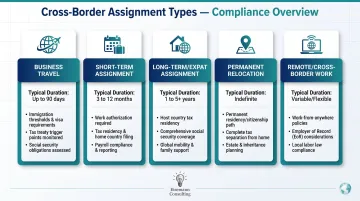
Remote and cross-border work deserves particular attention. An employee working from another country — even informally or temporarily — can trigger tax obligations, social security exposure, and corporate tax liability for the employer. Deloitte's global mobility surveys on travel and remote work have found that fewer than half of companies have formal policies for remote cross-border arrangements — making it the fastest-growing compliance gap in mobility programs today.
Key Components of an Effective Global Mobility Program
Immigration and Visa Compliance
Every cross-border move requires proper work authorization for the employee — and the requirements vary significantly by country, nationality, assignment type, and duration. An employee working on the wrong visa, or continuing to work after a permit lapses, creates serious exposure.
Consequences for employers include civil penalties, criminal liability for pattern violations, and in the UK, suspension or revocation of sponsor licences that affect all sponsored workers. Baker McKenzie's 2026 analysis highlights that updated I-9 penalty frameworks are increasing employer liability exposure. The short version: immigration non-compliance is expensive and damaging in ways that extend well beyond a single case.
For mid-market companies, the most common visa categories in cross-border assignments include H-1B, L-1, O-1, TN, and E-3 — each with distinct eligibility criteria, timelines, and employer obligations.
Tax Compliance and Equalization
Mobile employees can become taxable in two countries simultaneously. Without proactive planning, that means the employee pays more tax than they would at home — which either becomes a hidden cost the company absorbs or a financial penalty the employee bears.
Tax equalization addresses this directly. As PwC defines it, the policy ensures an assignee pays approximately the same tax they would have in their home country, regardless of where they're deployed. The company makes up the difference or captures the savings, keeping the employee financially whole.
Social security planning adds another dimension. The Social Security Administration estimates that totalization agreements save U.S. businesses and workers approximately $1.5 billion annually in foreign social security taxes. Without those agreements — or without proactively applying them — companies and employees face dual contributions on the same earnings.
Payroll Management
Tax and social security obligations feed directly into how payroll must be structured. Cross-border assignments rarely fit neatly into a single payroll system, and the decisions made here have compliance consequences in both countries. Questions that need answers before an assignment starts include:
- Which country runs payroll — home, host, or a split arrangement?
- Is a shadow payroll required to meet host country withholding obligations?
- How are currency fluctuations handled?
- What are the employer contribution requirements in the host jurisdiction?
Getting this wrong creates compliance risk in both countries and produces errors that are expensive and time-consuming to unwind.
Compensation, Benefits, and Relocation Support
A standard mobility package covers the employee's financial exposure across the assignment lifecycle. Common components include:
- Housing allowances and cost-of-living adjustments
- Hardship premiums for difficult or high-risk locations
- Health coverage and dependent education support
- Household goods shipping and settling-in support
Benefit design matters beyond retention — how allowances are structured affects tax liability for both the employee and the company.
Talent Management and Repatriation Planning
The mobility program must connect to the talent strategy — defining who is eligible for assignments, how international experience ties to career advancement, and most critically, what happens when the assignment ends.
Repatriation is underprepared far more often than it should be. When an employee returns from two years abroad to find no clear role, no recognition of their experience, and no career pathway, they leave — and the investment in their development walks out with them. Companies that document the repatriation process before the first assignment launches consistently see higher retention and faster time-to-contribution when employees return.
Benefits of Having a Global Mobility Program
Speed and Risk Reduction
Without a formal program, companies either move too slowly — losing market timing — or move without compliance safeguards, creating legal and financial exposure. A program enables faster decisions because the framework already exists. Immigration counsel is already engaged. Tax advisors are already briefed. The process doesn't start from scratch every time.
One client that worked with Eisemann Consulting — a global tech company managing 2,000+ annual relocations across 50+ countries — achieved a 40% reduction in relocation timeframes and full immigration compliance across all regions after formalizing their program with tiered benefits structures and optimized vendor partnerships.
Talent Acquisition and Retention
Beyond operational gains, a formal mobility program expands who you can hire, creates development opportunities high performers actively seek, and reduces attrition by giving employees a clear path — including what happens after an assignment ends.
The same case study noted above achieved a 92% employee satisfaction score post-program redesign, compared to significant dissatisfaction under the prior ad-hoc approach.
Cost Control
Unmanaged mobility is almost always more expensive than a structured program. The cost drivers add up fast:
- Tax penalties and immigration violations
- Duplicate payroll errors across jurisdictions
- Failed assignments that require replacement and restart
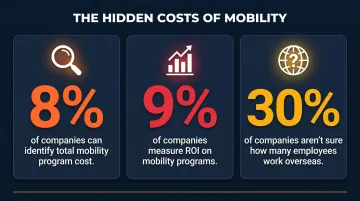
According to SHRM research, only 8% of companies can identify their total mobility program cost and only 9% measure ROI. That's cost invisibility, not cost control.
Proactive program management enables cost forecasting, policy standardization, and vendor coordination that reduces total program spend.
Common Challenges (and How to Navigate Them)
Compliance Complexity and Permanent Establishment Risk
Each country operates under its own immigration rules, tax treaties, labor laws, and social security framework — and these change. One risk that mid-market companies frequently underestimate is permanent establishment (PE): the scenario where an employee's presence in a country triggers corporate tax liability for the employer.
Remote work has made this more acute. A home office can qualify as a fixed place of business under certain conditions, potentially exposing the employer to tax obligations in a country where they have no formal structure. EY's analysis of OECD 2025 updates clarified when remote work creates PE risk — and when it doesn't — but the assessment requires case-by-case review.
The solution: build compliance review into the assignment approval process. PE risk should be evaluated before approving a move, not discovered during a tax audit.
Cost Overruns and Program Invisibility
Compliance gaps don't exist in isolation — they compound when no one has visibility into what's actually happening across assignments.
SHRM's data puts it plainly: 30% of companies aren't sure how many employees are working overseas. When assignment costs are scattered across HR, finance, legal, and vendor invoices, no one has a complete picture.
Centralization fixes this. Practically, that means:
- Assignment data consolidated in one system
- Cost projections run before approvals, not after
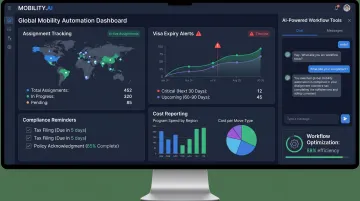
- Automated compliance deadline alerts replacing manual calendar tracking
- Reporting dashboards that give leadership a real-time program spend view — not a quarterly spreadsheet
Employee Experience and Assignment Failure
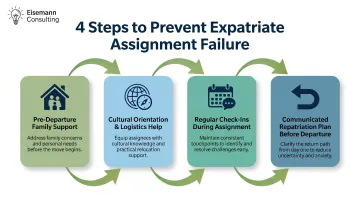
Research published in Frontiers in Psychology identifies family members' inability to adjust as one of the most critical drivers of expatriate assignment failure — not job performance, not technical skills. The employee might be thriving professionally while their family is struggling, and that dynamic rarely surfaces until it forces a resignation.
Prevention looks like:
- Pre-departure support that includes the whole family, not just the employee
- Cultural orientation and practical logistics help early in the process
- Regular check-ins during the assignment
- A clear, communicated repatriation plan before departure
How to Build Your Global Mobility Program: A Step-by-Step Approach
Step 1 — Define Purpose and Scope
Before designing policies, answer a simpler question: what does the business need mobility to accomplish? Market expansion, leadership development, knowledge transfer, and international hiring each require different program designs.
Identifying which assignment types the company needs to support — now and in the next 12–24 months — prevents the common failure mode of building a program around logistics rather than business outcomes.
Step 2 — Engage Stakeholders Before Building Policies
A functional mobility program requires genuine buy-in from HR, finance, payroll, legal, IT, and business unit leaders. Each function needs a named owner:
- Who approves assignments
- Who controls the budget
- Who signs off on compliance
- Who manages exceptions
Map this before the first assignment launches. Discovering ownership gaps mid-move creates delays and exposes the company to exactly the compliance risks the program was built to prevent.
Step 3 — Build the Policy Framework
Policy development means defining:
- Assignment types and eligibility criteria
- Benefit tiers (executive packages vs. project-level packages typically differ significantly)
- Cost allocation between home and host business units
- Employee support at each stage: pre-departure, during assignment, repatriation
Policies need to be written, accessible, and consistently applied. When policies live only in institutional memory, enforcement breaks down — and so does compliance.
Step 4 — Establish Compliance Processes and Vendor Relationships
The operational infrastructure includes:
- Immigration counsel engaged and briefed on key markets
- Tax advisors in host jurisdictions
- Payroll processes documented for cross-border scenarios
- A system to track compliance deadlines and visa expiry dates
Mid-market companies typically don't need a large in-house team to accomplish this. Working with a global mobility consultant provides access to established vendor networks, proven compliance processes, and specialist expertise at a fraction of the cost of building that capability internally. Eisemann Consulting's Global Mobility Essentials package ($2,500/month) is specifically designed for this scenario — giving growing companies the infrastructure of a mature mobility function without the overhead.
Step 5 — Implement Tracking, Reporting, and Continuous Improvement
The program needs ongoing data management across several dimensions:
- Who is on assignment and where
- Visa status and expiry dates
- Assignment cost against budget
- Business objective tied to each move
Mercer research shows 53% of mobility functions still rely primarily on Excel and Word. That creates manual error, compliance blind spots, and reporting delays.
AI-powered automation now fills this gap — flagging expiring visas, automating compliance reminders, and generating cost reports. Eisemann Consulting's AI automation implementations have delivered a 60% reduction in manual touchpoints and 45% faster cycle times for clients, using tools like Zapier, Airtable, and Retool alongside custom ROI tracking dashboards.
Frequently Asked Questions
What is a global mobility program?
A global mobility program is the formal system of policies, processes, and support structures a company uses to manage employee moves across international borders. It covers immigration, tax compliance, payroll, relocation logistics, and career planning for mobile employees.
What is a global mobility strategy?
A global mobility strategy defines the business logic — why and where the company deploys talent internationally, linked to goals like market expansion or leadership development. The program is the operational engine that executes those moves — compliantly and at scale.
How does global mobility work?
A business identifies the need to place talent in another country. The mobility program activates to handle immigration authorization, tax and payroll setup, and relocation logistics. Ongoing compliance management continues for the duration of the assignment.
What do global mobility managers do?
Global mobility managers oversee the full assignment lifecycle — ensuring immigration and tax compliance, coordinating with internal teams and external advisors, supporting relocating employees and their families, and maintaining program policies and vendor relationships.
What is a global mobility consultant?
A global mobility consultant provides expert advisory and operational support to companies without a full in-house mobility team. They help design programs, manage compliance, optimize costs, and coordinate with immigration attorneys and tax advisors.
How do you manage global mobility effectively?
Effective management requires a formal policy framework, clear cross-functional ownership, proactive compliance processes, and technology to track assignments and deadlines. Review program performance regularly against the business objectives that drive each move.