Introduction
Most growing companies run talent management and global mobility as parallel functions that rarely genuinely intersect. HR owns workforce planning, performance, and succession. Mobility teams handle visas, compliance, and the logistics of getting people where they need to be. The gap between them is rarely deliberate — it's structural. And it's expensive.
According to the EY 2025 Mobility Reimagined Survey, 90% of employers acknowledge the benefits of aligning talent mobility with wider strategic objectives — but only 30% have successfully achieved it. That 60-point gap between recognition and execution is where growth stalls and top talent walks out the door.
This article makes the case for why mobility should drive from talent strategy, not simply connect to it after decisions are made. We'll cover what that alignment looks like in practice, how to build it inside a mid-market company, and the structural barriers most teams hit along the way.
Key Takeaways
- Talent management and global mobility are strategically linked — but operationally siloed in most companies
- Mobility should stem from talent strategy — not get looped in after business units have already decided who's moving
- The mobility function is evolving from administrative relocation management toward strategic talent brokering
- Alignment requires shared data, joint planning cycles, and a clear business purpose behind every assignment
- Mid-market companies stand to gain the most from getting this right early, and lose the most from getting it wrong
Why Talent Management and Global Mobility Often Operate in Silos
The disconnect traces back to org design, not intent.
Global mobility commonly sits inside HR Operations or Finance, where it's evaluated on cost control and process compliance rather than talent outcomes. That placement creates a self-reinforcing loop: mobility teams optimize for what they're measured on — and no one's measuring them on career development or succession impact.
The "Afterthought" Problem
The typical workflow looks like this: a business unit identifies a need, requests a relocation, and mobility executes it. Talent management is rarely in the room when that decision is made. There's no check against succession plans, no evaluation of whether the selected employee is the right developmental move, no consideration of retention risk.
The data reflects that gap directly:
- Talent teams track performance ratings, potential assessments, and career pathing data
- Mobility teams track assignment status, cost, and compliance
- Only 8% of companies report having fully integrated talent management and mobility systems, per Mercer research
That systems gap has a functional consequence. The EY 2025 survey found only 19% of mobility functions are classified as "high trust" — strategically integrated and data-driven. The remaining 81% operate in an administrative or compliance-oriented mode that keeps them structurally disconnected from talent strategy.
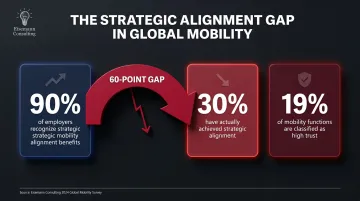
Until mobility is measured on talent outcomes — not just cost and compliance — that 81% won't shrink.
The Strategic Case: Why Alignment Drives Real Business Outcomes
Misalignment between talent management and global mobility produces direct, measurable business costs — and most companies are already absorbing them.
The Cost of Getting It Wrong
- Expensive assignments miss their purpose. When moves aren't tied to development goals, they consume relocation budgets without building the leadership pipeline the business actually needs.
- High-potential employees leave. When mobility opportunities bypass high performers — because selection is informal and disconnected from talent reviews — those employees notice. And they start looking externally.
- Market entry slows. Without integrated workforce planning, companies can't move the right skills into new markets ahead of demand. They react late, after the need is already urgent.
74% of employers face delays filling senior roles, with some gaps extending beyond a year, according to EY's 2025 research. That's not a recruiting problem in isolation — it's often a mobility and succession alignment failure.
The Retention Argument
Employees who receive international opportunities tied to a visible career path respond differently than those who experience relocation as a disconnected transaction. The evidence is direct: 80% of employees say a recent international mobility experience increased their likelihood of staying with their employer. Without a clear development purpose and repatriation support, that retention lift disappears — and the assignment cost becomes a liability instead of an investment.
Expansion Speed and Revenue Impact
Retention is only part of the story. When workforce planning, succession data, and mobility programs share the same strategic inputs, companies identify and move talent before the need becomes urgent. Organizations with mobility programs integrated with talent and organizational goals are over twice as likely to achieve 10% revenue growth, and evolved mobility functions are 1.9 times faster at deploying employees to new markets.
DEI Outcomes
The same integrated approach that improves retention and market speed also shapes who gets international opportunities. Structured selection criteria improve diversity in assignments — yet only approximately 4% of companies have a documented diversity strategy specifically for their mobility programs. When informal nomination — essentially, whoever a manager thinks of first — governs selection, the same demographic patterns repeat. Criteria-based selection tied to talent strategy widens the candidate pool systematically, not by chance.
Shifting the Role: From Relocation Manager to Global Talent Broker
Mercer's research on this shift frames the evolved mobility role as "global talent brokering" — actively matching international assignment opportunities to development needs, succession plans, and business expansion goals rather than coordinating logistics after decisions have already been made.
What "Talent Broker" Actually Means Day-to-Day
The practical difference is significant:
Traditional relocation manager:
- Receives an assignment request from a business unit
- Processes immigration, compliance, and logistics
- Tracks cost and status to completion
Global talent broker:
- Joins workforce planning conversations before decisions are finalized
- Contributes mobility intelligence — which roles are mobile-ready, what locations are feasible, realistic timelines
- Flags misalignments between requested moves and talent strategy
- Connects employees with skills to business units with gaps
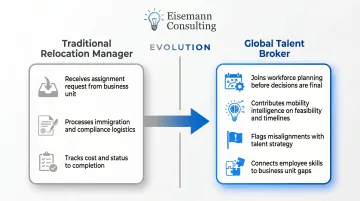
Making this shift requires mobility professionals to develop fluency in talent management frameworks — succession planning, skills gap analysis, performance data — and to build working relationships with HR business partners. That's a fundamentally different capability set than logistics coordination.
Why Mid-Market Companies Have the Advantage Here
Enterprise organizations often struggle to make this shift because entrenched silos between HR, Talent, and Mobility are difficult to dismantle at scale.
Mid-market companies operate differently. The HR and mobility functions are small enough to collaborate directly, flexible enough to restructure quickly, and close enough to business leadership to make the case without bureaucratic layers in between.
That's the window. Companies at Series A through C that build strategic mobility capabilities now avoid the calcified structures that make this harder later. Eisemann Consulting works with mid-market clients on exactly this transition — helping mobility professionals reposition as strategic partners while the organizational structure still allows for it.
A Practical Framework for Aligning Talent Management and Global Mobility
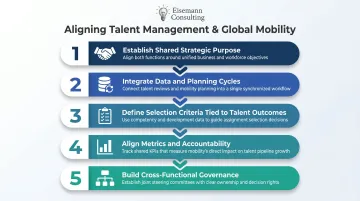
Step 1 — Establish Shared Strategic Purpose
Before any structural or process change, HR, talent management, and mobility teams need agreement on what problem mobility is actually meant to solve. Is it filling critical skill gaps? Building a global leadership bench? Supporting market entry? Retaining high performers?
Document this in a joint mobility charter or policy preamble. Without it, each team defaults to its own definition of success, and those definitions will always conflict.
Step 2 — Integrate Data and Planning Cycles
Talent review outputs — 9-box assessments, succession slates, skills inventories — should feed directly into mobility program design. In practice, this means:
- Building a joint planning cadence where mobility informs talent reviews
- Ensuring talent review outputs are accessible to mobility planners, not siloed in HR systems
- Creating a shared assignment pipeline that reflects succession priorities, not just business unit requests
Step 3 — Define Selection Criteria Tied to Talent Outcomes
Replace "who's available" with structured criteria linked to:
- Development goals and succession readiness
- Skills the organization needs to build
- Retention risk for the employee if the opportunity is passed over
This protects program integrity and DEI commitments at the same time.
Step 4 — Align Metrics and Accountability
Mobility programs measured only on cost and compliance will consistently underserve talent strategy. The EY 2025 survey found that evolved mobility functions track outcome-oriented metrics — performance ratings post-assignment (68%), revenue impact (63%), and promotion rates (59%) — rather than just cost per move.
Useful shared KPIs to introduce:
- Post-assignment retention rate (12 and 24 months)
- Internal fill rate using repatriated talent
- Leadership pipeline contribution from mobility alumni
- Time-to-deployment for critical roles in new markets
Redesigning these measurement frameworks is central to Eisemann Consulting's advisory work with mid-market clients — giving mobility teams the data to demonstrate talent ROI alongside program efficiency.
Step 5 — Build Cross-Functional Governance
A lightweight governance model that actually works for mid-market companies:
- Recurring talent-mobility working group — monthly or quarterly
- Participants: HR business partners, talent management leads, mobility operations
- Agenda: Review upcoming assignment demand against talent strategy; flag misalignments before moves are initiated
- Escalation path: Clear owner for decisions when business unit requests conflict with talent priorities
A standing meeting with shared accountability is enough to make this work — no org chart changes required.
Overcoming the Most Common Barriers to Alignment
Administrative Overload
62% of mobility functions spend the majority of their time on reactive, administrative tasks rather than strategic activity. When the team is buried in visa paperwork and compliance tracking, strategic talent partnership becomes impossible.
it gets structurally cut out of talent decisions, no matter how strong the individual relationships are.
Companies should audit their reporting lines directly: Does mobility have access to talent planning forums? Can mobility professionals see succession data? Do they have relationships with HR business partners? If the answer to any of these is no, the structural problem needs to be fixed before the strategic one can be addressed.
The Cost Center Mindset
Many business leaders still treat mobility as an HR transaction rather than a talent lever. The most effective way to shift this is specific and concrete: connect two or three recent mobility investments to talent outcomes that leaders already care about.
For example:
- An assignment that filled a succession gap in a market the business was struggling to staff
- A repatriated employee who moved into a senior leadership role within 18 months
- A retention case where a high performer stayed because a visible international opportunity was on the table
The Global Tech Leader case in Eisemann Consulting's portfolio illustrates what that looks like at scale — a redesigned mobility program that delivered $45M in annual cost savings alongside a 40% reduction in relocation timeframes and a 92% employee satisfaction score. When leaders see both numbers on the same page, the "HR transaction" framing stops sticking.
Frequently Asked Questions
What is global talent mobility?
Global talent mobility refers to the movement of employees across borders, roles, or business units to fill skill gaps, develop leadership capability, and support business expansion. It covers international assignments, transfers, and structured development moves — not just relocation logistics.
What is a talent mobility program?
A talent mobility program is a structured approach to identifying, selecting, and supporting employees for moves within or across borders. The defining feature is that moves are tied to defined talent development or business objectives — not handled as ad hoc requests.
How does global mobility work?
The end-to-end process spans identifying the business need, selecting the right employee, managing immigration and compliance, and supporting relocation logistics. Each stage connects back to the employee's career development plan and the original talent objective.
Is global mobility part of HR?
Global mobility typically sits within HR, though it's sometimes housed in Finance or Legal. Strategic alignment requires integration with talent management functions — giving mobility access to succession data, talent reviews, and workforce planning.
What is the role of a global mobility manager?
Traditionally, the role covers visa management, compliance, and relocation logistics. The evolving version — often called a talent broker — involves workforce planning, advising on assignment decisions before they're finalized, and connecting mobility capabilities directly to talent gaps.
What is a global talent strategy?
A global talent strategy is an organization's plan for building and deploying the skills needed to hit business goals across international markets. Global mobility is one of its primary execution levers — and one of the most underused when the two functions operate in silos.