Introduction
Most organizations keep hiring externally while the talent they need is already on payroll. According to Veris Insights research, 39% of roles were filled by internal candidates in 2024, up from 32% the prior year — and nearly 70% of TA leaders say internal mobility is receiving greater investment heading into 2025.
The cost argument is equally stark. SHRM estimates that total replacement costs run 3–4x a position's annual salary. External hires also take roughly two years to reach full productivity, according to Wharton research — while internal moves skip most of that ramp entirely.
This guide walks HR and operations leaders at mid-market and scaling companies through building a practical internal talent mobility strategy, step by step. You don't need a dedicated mobility team or an enterprise platform budget — just a structured approach that cuts turnover, closes skills gaps, and reduces recruiting spend.
Key Takeaways
- 39% of 2024 roles were filled internally — and the share keeps climbing
- External hires cost 3–4x more and take ~2 years to reach full productivity
- Employees who move internally stay 60–65% longer than those who don't
- Most internal roles are filled before 51% of employees even hear about them
- Automation makes scaling these programs feasible even for lean HR teams
What Is Internal Talent Mobility?
Internal talent mobility is the deliberate, structured movement of employees across roles within an organization. The key word is "structured," meaning this goes well beyond informal promotions or the occasional manager-to-manager favor.
Four main types:
- Vertical mobility: Promotions into higher-level roles with expanded scope and responsibility
- Lateral mobility: Cross-department or cross-function moves at roughly the same level, designed to broaden skills
- Project-based mobility: Temporary assignments or stretch roles tied to specific initiatives
- Global mobility: Cross-border deployments supporting international operations or expansion
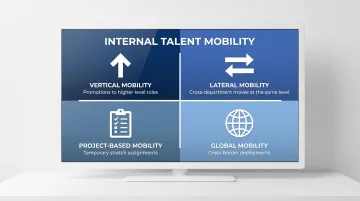
What separates a real internal mobility strategy from ad-hoc internal hiring is the infrastructure behind it: a skills inventory, defined eligibility criteria, transparent pathways, consistent communication, and actual leadership commitment. Posting a job on an internal board is not a strategy — that's recycling your external hiring process with a smaller audience. The sections below cover what building the real infrastructure actually looks like.
Why Internal Talent Mobility Is a Business Priority Right Now
The External Market Has Cooled — Permanently, for Now
From January 2023 to February 2025, job openings dropped 27%, new hires fell 15%, and voluntary resignations declined 17%. The "war for talent" framing that drove aggressive external recruiting has given way to a frozen labor market where building from within makes more sense.
Lightcast research shows employees who make at least one internal move stay 60–65% longer than external hires. Companies with active internal mobility programs retain employees for an average of 5.4 years — nearly twice the tenure at low-mobility peers.
The Financial Case Is Hard to Ignore
External hiring carries costs at every stage — sourcing, screening, onboarding, and the productivity gap that follows. Internal candidates skip most of that friction. The financial data makes the comparison stark:
- Internal promotes cost 18–20% less than external hires in comparable roles (Wharton)
- External hires receive lower performance evaluations for their first two years despite higher pay
- Early attrition hits hardest in the first 90 days — where internal candidates dramatically outperform
- Organizational knowledge in internal moves reduces ramp time and cuts early churn
Employees Are Already Looking
Gallup's most recent data shows 51% of U.S. employees are either actively job-searching or watching for opportunities — even as job market confidence has collapsed to just 28%. Employee engagement sits at a decade low of 31%.
Lack of career growth is consistently cited among the top reasons people leave. LinkedIn's 2025 Workplace Learning Report identifies career development as the #1 driver of retention, and more than 60% of employees who quit cited limited advancement as a key factor.
Internal mobility addresses this by making the next opportunity visible before employees start looking outside.
How to Build a Successful Internal Talent Mobility Strategy
Build the Business Case First
Before designing anything, HR leaders need executive buy-in. That requires connecting mobility to metrics leadership already tracks: cost-per-hire, time-to-fill, turnover cost, and headcount efficiency.
A simple framing: take your average external cost-per-hire (SHRM's 2025 benchmark is ~$5,475 for nonexecutive roles), multiply by annual external hire volume, and compare that against the cost of building an internal pipeline. For most mid-market companies, the math favors internal development by a wide margin — especially when you factor in the 3–4x salary multiplier for total replacement cost.
MIT Sloan research adds another angle: lateral career opportunities are more than twice as important as compensation in predicting employee retention. That's a retention lever executives can act on directly — no new budget required.
Map Your Skills Inventory
You can't move talent strategically if you don't know what skills exist in your workforce. A skills map doesn't require enterprise software.
Practical steps for a lean HR team:
- Employee self-reporting — use a simple form or survey asking employees to document current skills, past experience, and career interests
- Manager assessments — have managers rate team members against a defined competency framework for each role family
- Role-competency frameworks — define what skills are required at each level for key roles, creating a map of adjacency (what skills transfer between roles)
- Gap analysis — cross-reference current skills against future business priorities to identify where development investment is most needed
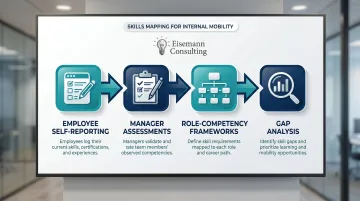
The goal is a working view of where skills live inside the organization — imperfect and updatable beats comprehensive and never-finished.
Design a Transparent Framework and Process
Without a formal process, internal mobility defaults to who knows whom. That's not mobility — it's favoritism with better optics.
Core governance components:
- Eligibility criteria — performance-based, not seniority-based; typically requires a minimum tenure in current role (often 12–18 months) and a defined performance threshold
- Standardized application process — same steps, same timeline, regardless of which department the candidate is moving into
- Internal-first posting window — post roles internally for a defined period (5–10 business days is common) before opening to external candidates
- Communication standards — applicants should receive updates at defined intervals; no ghosting internal candidates
Transparency matters more than most organizations realize. A Gartner survey reported by SHRM found that only 51% of employees are aware of internal job openings at their own company. Posting internally first costs nothing and closes the biggest gap in most programs.
Get Manager Buy-In and Break Talent Hoarding
This is where most programs stall. Managers resist losing high performers to other teams — and from where they sit, that resistance is rational. Their performance metrics don't reward developing talent for someone else's headcount.
How to break the pattern:
- Redesign incentives — track and reward managers for how many employees they've developed and exported to other parts of the business. Make "talent exporter" a positive performance metric
- Reframe the narrative — managers who develop mobile talent build reputations as strong developers of people, which attracts better candidates to their teams over time
- Address concerns directly — give managers transition timelines and backfill support rather than announcing mobility as an immediate loss
The goal is making mobility something managers actively participate in — not something imposed on them. Organizations where managers hoard talent show this pattern clearly in team-level mobility data — which becomes a coaching opportunity once you're tracking it.
Build Career Pathways and Development Programs
Effective career pathing doesn't require a linear org chart. Skills-based pathing maps adjacent competencies across roles so employees can see realistic, non-traditional paths — not just the one rung directly above them.
What this looks like in practice:
- A customer success manager sees a clear path to sales operations or implementation consulting based on transferable skills
- A finance analyst identifies a lateral move into HR data analytics using existing modeling skills
- Development plans are set during dedicated career conversations — separate from performance reviews — where employees articulate goals with manager support
Tie this to real development resources: mentorship programs, reskilling paths, cross-functional project assignments, and manager-sponsored stretch work. Pathways without development resources are aspirational at best — employees need funded, structured support to actually move.
Communicate and Engage Employees
Most mobility programs underperform not because employees aren't interested — they simply don't know the program exists or can't navigate it. Communicating more than feels necessary is the right default here.
Practical awareness tactics:
- Internal career hub or landing page with current openings and eligibility information
- Regular communications (email digest, Slack channel, intranet) featuring open roles
- Manager prompts to discuss internal opportunities during 1:1s — make it a standing agenda item
- Employee profile-building where employees document skills and career interests for HR visibility
Breaking Through the Most Common Roadblocks
| Roadblock | Root Cause | Fix |
|---|---|---|
| Managerial gatekeeping | Managers penalized for losing talent | Add "talent export" to manager performance metrics |
| Low employee awareness | No systematic communication | Standardized internal posting protocol + direct manager outreach |
| External hiring bias | Default preference for outside candidates | Formal internal-first posting window + hiring manager training on internal candidate value |
External bias deserves direct attention: many organizations post internally as a formality while the hiring manager has already committed to an outside search. Formalizing an internal-first window closes that gap — and training hiring managers on the actual data makes the case concrete:
- Faster ramp: Internal moves typically reach full productivity 30-50% faster than external hires
- Lower churn: Internal hires stay longer, reducing the rehiring cycle
- No salary premium: Internal candidates rarely require the compensation premium external candidates command
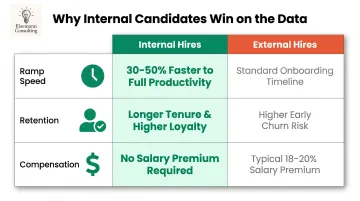
That combination addresses the structural incentive problem, not just the surface behavior.
Using Automation and AI to Scale Your Internal Mobility Program
Where Manual Processes Break Down
Well-designed mobility programs fail at scale when execution relies on manual effort. Application routing, skills matching, job alert notifications, and internal onboarding sequences all involve repetitive steps that bottleneck HR teams — and that bottleneck grows with every new role and every additional employee.
Eisemann Consulting's workflow automation work with HR teams shows that process optimization can reduce manual touchpoints by 60% and cut cycle times by 45% — outcomes that apply directly to internal mobility workflows where routing, communication, and tracking dominate the workload.
Specific Automation Use Cases for Internal Mobility
Accessible tools like Zapier and Airtable can power most of this without enterprise software:
- Notify relevant employee segments automatically when matching roles post, based on skills profile data
- Route applications to hiring managers and track status without manual follow-up
- Deliver role-specific onboarding sequences that skip company-wide content — internal hires already know the culture
- Trigger scheduled reminders for employees and managers to keep skills data current
Those automation gains cover the operational layer. AI-powered matching addresses a harder problem: who gets seen. Unlike keyword search, AI uses skills adjacency and career trajectory data to surface candidates a hiring manager might not have considered. It also reduces reliance on personal networks, which can quietly limit who gets visibility.
Gartner recommends redirecting one-third of total recruiting capacity toward internal candidates as AI makes that matching feasible at scale.
For mid-market and scaling companies without enterprise HR platforms, Eisemann Consulting's AI Automation Starter ($8,000 one-time) builds 3–5 custom AI workflows that integrate with existing tools — Zapier, Airtable, Google Workspace, Notion, Slack — and includes team training with 30 days of optimization support. Teams that aren't sure where to start can use the free 72-hour operational fix offer to diagnose the biggest bottleneck in their current mobility process before committing to anything larger.
Measuring the ROI of Your Internal Mobility Program
Key Metrics by Stakeholder
| Metric | Why It Matters | Speaks To |
|---|---|---|
| % of open roles filled internally | Headline program health metric | All stakeholders |
| Internal vs. external time-to-fill | Quantifies process efficiency | HR and operations leaders |
| Retention rate of internally mobile employees | Shows long-term retention impact | CFO, CEO |
| Cost savings from reduced external recruiting | Translates to budget dollars | Finance |
| Time-to-productivity for internal hires | Shows value relative to external candidates | Hiring managers |
| Employee engagement scores | Indicates whether mobility improves experience | HR, CHRO |
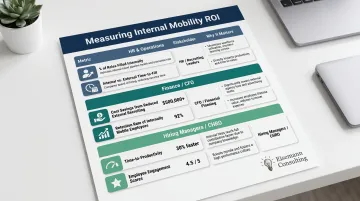
Those metrics capture program health — but not the full picture. Track DEI data alongside them, because internal mobility programs that aren't actively monitored for equity tend to replicate the same visibility gaps as external hiring, with promotions and lateral moves clustering in already-advantaged groups.
From Tracking to Optimizing
How you use the data matters as much as which metrics you track:
- Roles that are consistently hard to fill internally signal training or development gaps worth addressing
- Team-level mobility data surfaces talent hoarding by specific managers
- Cohort analysis of who moves (and who doesn't) identifies structural equity gaps
Report results to leadership in business terms — cost savings, headcount efficiency, retention rates — not HR process language. When executives see mobility tied directly to reduced recruiting spend and faster time-to-productivity, budget and support follow.
Frequently Asked Questions
What is an internal mobility program?
An internal mobility program is a structured organizational process that enables employees to move into new roles — lateral, vertical, or project-based — within the same company. It includes defined eligibility criteria, clear communication channels, and development support to make those transitions successful.
What is an example of internal mobility?
Two common examples: a sales operations analyst moving laterally into a product manager role using transferable process skills, or a customer success manager promoted to team lead after completing a leadership development program — both without external recruiting.
How will AI-driven tools transform internal mobility?
AI enables skills-based matching that surfaces non-obvious internal candidates and automates application routing. It also uses career trajectory data to recommend development pathways — giving even small HR teams the ability to run mobility programs without enterprise-level platforms.
What are the 5 C's of employee retention?
The 5 C's are Compensation, Career development, Culture, Connection, and Contribution. Internal mobility directly strengthens Career development — by making advancement visible and accessible — and Connection, by building relationships across teams.
How do you measure the success of an internal mobility program?
Track a combination of quantitative and qualitative signals: internal hire rate, time-to-fill for open roles, employee retention among program participants, and internal application volume. Qualitative indicators — like manager confidence in cross-functional placements — round out the picture.