Introduction
Most founders don't plan to become their company's top salesperson. It just happens. You close the first few clients yourself, then a few more, and suddenly your entire revenue engine runs through your calendar.
That works — until the cracks appear.
The breaking point usually hits somewhere between $1M and $3M ARR: pipeline visibility disappears, new sales hires underperform because there's no playbook, and forecast accuracy becomes guesswork. Growth stalls not because demand dried up, but because the sales function never matured beyond one person's hustle.
A fractional Chief Sales Officer brings the structure, strategy, and accountability your revenue function needs — without the $400K+ cost of a full-time C-suite hire. This guide covers what a fractional CSO actually does, what they cost, how to know if you need one, and how to find the right fit.
Key Takeaways
- A Fractional CSO is a senior sales executive who works part-time or on contract to lead sales strategy, build processes, and drive revenue.
- They cover the full CSO scope—pipeline, forecasting, team development, quota design—at a fraction of the cost.
- Startups, SMBs, and Series A–C mid-market companies that need C-suite sales leadership without committing to a permanent hire.
- Cost comparison: Full-time CSO total compensation averages $460K/year; fractional retainers typically run $10,000–$22,000/month.
What Is a Fractional Chief Sales Officer?
A Fractional CSO is an outsourced senior sales executive who engages on a part-time or project basis—typically 2–3 days per week under a monthly retainer—to own sales strategy and revenue performance. The accountability mirrors a full-time CSO; the engagement model does not.
They carry quota responsibility, report directly to the CEO, and make real decisions. They're not advisors who show up once a month to review slides.
How It Differs from a Full-Time CSO
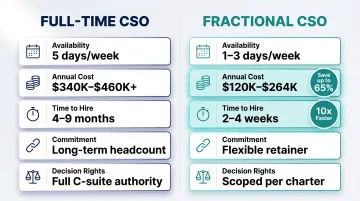
The scope is nearly identical. The differences are structural:
| Factor | Full-Time CSO | Fractional CSO |
|---|---|---|
| Availability | 5 days/week | 1–3 days/week |
| Annual cost | $340K–$460K+ | $120K–$264K (annualized retainer) |
| Time to hire | 4–9 months | 2–4 weeks |
| Commitment | Long-term headcount | Project or retainer, flexible |
| Decision rights | Full C-suite authority | Scoped per engagement charter |
Fractional CSO vs. Fractional CRO
These titles get used interchangeably at smaller companies, but the distinction matters:
- Fractional CSO: Focused specifically on the sales function: pipeline, team, process, quota attainment
- Fractional CRO: Broader commercial ownership covering sales plus marketing, partnerships, and customer success
If your primary need is fixing the sales engine, a CSO scope is the right fit. If you need someone owning the entire revenue lifecycle, you're describing a CRO.
Why This Model Has Surged
The fractional executive model isn't a niche workaround anymore. According to Fractional C-Suite, job postings referencing fractional leadership grew 400% since 2022, with demand up 68% year-over-year between 2023 and 2024. The global fractional executive market hit $5.7 billion in 2024, growing at 14% annually.
For mid-market companies weighing a $400K+ full-time hire against a $150K retainer that can start in weeks, those numbers reflect a real shift in how leadership capacity gets structured.
What Does a Fractional Chief Sales Officer Do?
The core job is building a revenue engine—not closing deals personally, but designing the system, processes, and team capabilities that produce consistent, predictable revenue.
Sales Strategy and Revenue Architecture
Before anything tactical, the Fractional CSO answers the strategic questions most founder-led sales organizations skip:
- Which customer segments should we prioritize, and why?
- What's the right go-to-market motion—inbound, outbound, channel, or a combination?
- How should quota be structured, and are territory maps logical?
- Where do sales goals connect to the broader business plan?
Skipping this layer means reps work hard—just not toward the segments or motions that actually convert.
Sales Process and Forecasting
Broken forecasting is one of the most common—and most fixable—problems a Fractional CSO inherits.
Most companies growing past $2M ARR are still running on gut-feel forecasting—a mix of rep confidence levels and optimistic assumptions. A Fractional CSO replaces that with:
- Stage-gated pipeline definitions so every deal is evaluated consistently
- CRM discipline with clear data hygiene standards reps actually follow
- Forecast models that give leadership board-ready revenue visibility
When leadership can see what the pipeline data actually supports, financial planning, hiring decisions, and board conversations all get sharper.
Team Development and Enablement
A Fractional CSO's coaching mandate includes:
- Training and mentoring sales managers and individual contributors
- Building playbooks: discovery frameworks, objection-handling guides, mutual action plans
- Structuring onboarding so new hires ramp in weeks, not quarters
- Establishing a regular coaching cadence so performance doesn't depend on the top rep carrying everyone else
Pipeline Management and Coverage
Healthy pipeline doesn't happen by accident. The Fractional CSO designs inbound and outbound lead flows, sets MQL-to-SQL handoff standards with marketing, and monitors pipeline coverage ratios.
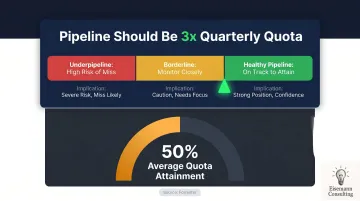
In B2B sales operations, the standard benchmark is clear: pipeline value should be approximately 3x your quarterly quota target. Miss that threshold consistently, and you're not just forecasting a bad quarter—you're confirming a structural process problem. Given that Forrester reports company quota attainment sits around 50% across sales organizations, having someone who actively manages pipeline health rather than reacting to misses is the difference between predictable revenue and quarterly panic.
Key Benefits of Hiring a Fractional CSO
Cost Efficiency Without Sacrificing Expertise
Glassdoor reports average total compensation for a full-time Chief Sales Officer at $460,232/year, with top-quartile earners reaching $633,000+. Add employer-side costs — benefits, taxes, equity — and the real number climbs higher.
Fractional CSO retainers run $10,000–$22,000/month depending on engagement intensity, annualizing to roughly $120,000–$264,000. That's the full scope of C-suite sales leadership at 30–40% of the full-time cost.
For a Series B company with $8M ARR, that difference funds two additional sales reps.
Speed to Impact
Retained executive searches for C-suite roles average 6–9 months. A fractional CSO can typically onboard in 2–4 weeks and deliver early wins almost immediately:
- CRM hygiene audit and cleanup
- Pipeline re-qualification (removing zombie deals inflating the forecast)
- Forecast model rebuild
- First rep coaching sessions
A single quarter operating with a broken forecast or stalled pipeline — while a full-time search drags on — can cost a growth-stage company 15–25% of annual revenue targets. That's the gap a fractional CSO closes fast.
Flexibility That Matches Your Stage
The engagement expands or contracts based on what the business actually needs. Fundraise prep requires different intensity than steady-state optimization. Entering a new market requires different support than cleaning up a team that's underperforming.
Fractional engagements are structured around defined deliverables, not open-ended tenure: structured scope, clear milestones, no long-term contracts that outlast the actual need. When the work is done, the engagement ends. You're not carrying executive overhead through a plateau.
Signs Your Business Needs a Fractional Chief Sales Officer
Most sales problems look like execution issues on the surface. But recurring patterns across pipeline, leadership, team performance, and major business events usually point to something structural. Here's what to watch for.
Pipeline and Forecast Instability
Quantitative red flags that signal a structural problem, not just a bad quarter:
- Revenue targets missed despite visible market demand
- Pipeline coverage consistently below 3x quarterly quota
- Forecast variance so wide it makes planning unreliable
- Deals that were "closing this quarter" keep pushing without clear reason
Growth Is Stuck in Founder Mode
The founder-led sales ceiling is real . B2B companies typically hit this wall between $800K and $2M ARR. The symptoms:
- CEO or founder is still the primary—or only—reliable closer
- New sales hires close at 10–15% versus the founder's 35%+ close rate
- No documented sales process means every rep figures it out independently
- Company growth is capped by one person's availability
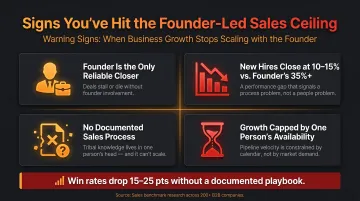
Win rates drop 15–25 percentage points when deals move from founder to reps without a repeatable playbook. Without a structured handoff process, that gap compounds as you add headcount.
Team Performance Is Inconsistent
A sales team without dedicated leadership develops predictable patterns:
- One or two top performers carrying everyone else
- No documented process, so "how we sell" lives in individual reps' heads
- Wide variance in outcomes across the team with no clear explanation
- No regular coaching cadence, so performance only gets addressed when it's already a problem
A Major Business Event Requires Sales Credibility
Certain moments demand predictable revenue projections, not optimistic guesses:
- Fundraising: Investors underwrite future revenue, not past hope
- M&A activity: Acquirers discount founder-dependent pipelines heavily
- New market entry: A structured go-to-market beats improvising in unfamiliar territory
- Revenue recovery: Stagnant or declining sales need diagnosis, not cheerleading
How to Find and Hire the Right Fractional CSO
Define What You Actually Need First
Before evaluating candidates, document the specifics:
- What revenue outcomes do you need? (Restore forecast accuracy? Build an outbound motion? Fix onboarding?)
- What's the engagement model—hours per week, retainer vs. project?
- What decision rights are you prepared to give? Comp plan revisions, hiring and firing authority?
Experienced fractional CSOs will ask these questions in the first conversation. If your team can't answer them, that's the actual problem to solve before the search begins.
Evaluate for Stage Fit and Proven Outcomes
Once you've defined the need, you can evaluate candidates against it—not just against an impressive résumé.
An impressive company name doesn't guarantee the right fit. Ask for specifics:
- Win rate improvements at companies your size
- ARR growth they directly influenced
- Forecast accuracy improvements with before/after data
- How they handled the specific challenge you're facing
The right fractional CSO has worked at a comparable stage and market. Enterprise-to-startup experience rarely transfers as smoothly as a résumé suggests.
Structure the Engagement for Day 1 Accountability
Clear structure early on separates engagements that deliver from ones that drift. Set it up properly:
- Get a signed engagement charter that defines KPIs, decision rights, and out-of-scope areas before work begins
- Provide CRM and pipeline access before the first billable day—week one should move fast, not stall on data requests
- Agree on a 30/60/90-day deliverable plan with specific outcomes at each milestone, not just "get up to speed"
- Schedule regular CEO check-ins—weekly at the start, biweekly once the engagement finds its rhythm
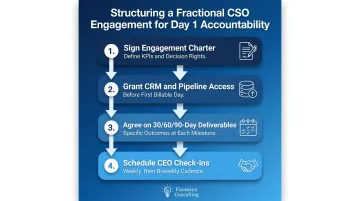
A fractional CSO who resists this structure is signaling they're not accountable to outcomes—which is the only reason to bring one in.
Frequently Asked Questions
What does a fractional chief sales officer do?
A fractional CSO leads sales strategy, builds pipeline processes, coaches the sales team, and owns revenue performance—the same scope as a full-time CSO. The difference is engagement model: they work part-time, typically 1–3 days per week under a monthly retainer, rather than as a permanent hire.
What is the 10-3-1 rule in sales?
Developed by Al Granum, the 10-3-1 rule states that for every 10 qualified prospects contacted, 3 will agree to a conversation and 1 will become a client. A fractional CSO uses benchmarks like this to set activity targets and pipeline expectations, making clear that volume and qualification—not just effort—drive outcomes.
What is the 3-3-3 rule in sales?
The 3-3-3 rule is an outreach framework: contact 3 prospects via 3 different channels (email, phone, LinkedIn) across 3 defined timeframes before moving on. A fractional CSO builds cadences like this into outbound playbooks so leads don't go cold from inconsistent follow-up.
How much does a fractional CSO cost?
Fractional CSO retainers typically range from $10,000 to $22,000/month depending on engagement intensity, seniority, and scope—annualizing to $120,000–$264,000. Compared to a full-time CSO's average total compensation of $460,000+/year, that's roughly 30–40% of the full-time cost for equivalent expertise.
When should you hire a fractional CSO instead of a full-time CSO?
A fractional CSO is the right choice when you need senior sales leadership but don't yet have the revenue base, budget, or long-term certainty to justify a permanent hire. This typically applies at Series A–B stage, during a growth plateau, ahead of a fundraise, or when you need impact faster than a 6–9 month executive search allows.