Introduction
More customers. More revenue. More things breaking.
That's the paradox many growing businesses hit around the $5M–$15M mark. The sales are there. The demand is real. But the operations were never designed to handle it — so more growth just means more firefighting.
McKinsey research analyzing nearly 5,000 global businesses found that 85% of companies failed to achieve both revenue growth and improved profitability between 2019 and 2024. The culprit isn't market conditions. It's operational infrastructure that couldn't keep pace with demand.
This article covers what operational scalability actually means, how to catch the warning signs early, the five foundations every growing business needs, and how automation and the right expertise turn scaling into a competitive advantage — not a constant scramble.
Key Takeaways
- Operational scalability means growing revenue without proportional increases in cost, manual effort, or operational breakdowns
- The top scalability killers: manual processes, founder bottlenecks, fragmented systems, and no real-time financial visibility
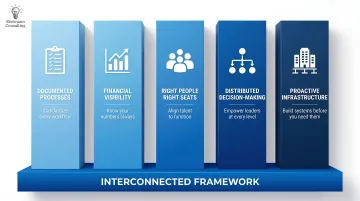
- Five foundations drive scalable operations: documented processes, financial visibility, the right team structure, decision distribution, and proactive infrastructure
- Automation tools can eliminate 10–20 hours of manual work per week and reduce process cycle times by 65–70%
- The right consulting partner identifies root constraints and delivers working solutions with measurable outcomes
What Is Operational Scalability (and Why Most Businesses Get It Wrong)
Operational scalability is the ability to grow — more clients, more revenue, more complexity — without breaking your systems, exhausting your team, or shrinking your margins.
That last part is where most businesses stumble. They equate scaling with selling more. Scalable growth means revenue expanding faster than cost and complexity — not just bigger numbers. When companies miss that distinction, they often discover that growing from $5M to $15M actually made them less profitable, because every new client required more time, more headcount, and more manual effort to deliver.
Who Needs This Most
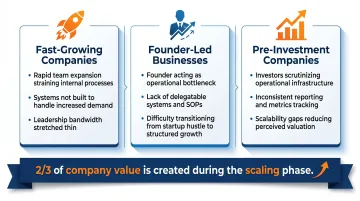
Three business profiles face this challenge most acutely:
- Fast-growing companies adding clients faster than they can deliver — systems that worked at $3M break down at $10M
- Founder-led businesses where everything runs through one person — growth stalls because the founder is the process
- Companies preparing for investment or acquisition — operational soundness is scrutinized heavily during due diligence, and undocumented, founder-dependent operations are red flags
Investopedia notes that two-thirds of a company's value is created during the scaling phase — making operational readiness not just an efficiency question, but a valuation question.
Warning Signs Your Operations Are Holding You Back
Most operational problems don't arrive as emergencies. They build up gradually until they're impossible to ignore.
Early-Stage Warning Signs
- Tasks done manually that could easily be automated
- The same questions answered repeatedly by the same people
- Leadership making low-level decisions daily because there's no documented process to follow
- Team members building workarounds rather than fixing the underlying system
Mid-Growth Crisis Signs
- Customer complaints rising as headcount grows
- Margins shrinking despite revenue growth
- New employee onboarding taking weeks instead of days
- Delivery quality becoming inconsistent across clients or projects
Asana's Anatomy of Work Index found that knowledge workers spend roughly 60% of their time on "work about work" — chasing updates, duplicating effort, sitting in unnecessary meetings. The root cause isn't how people manage their time — it's the absence of systems that eliminate the friction in the first place.
The Founder Bottleneck
When every significant decision still requires the owner or a single senior leader — approvals, client communications, hiring, pricing exceptions — the company has a growth ceiling baked into its org chart. The team isn't slow, and the market isn't the problem. The structure is.
Forbes Business Council identifies this pattern directly: founders frequently become the primary bottleneck to their own company's growth by maintaining over-centralized decision-making long after the business has outgrown it. The habits that created early success, personal oversight of everything, eventually prevent the business from scaling at all.
The 5 Pillars of Operational Scalability for Growing Businesses
These five pillars function as an interconnected framework. Each one builds on the others, and the absence of any single pillar creates a weak point that worsens under growth pressure.
Pillar 1: Build Repeatable, Documented Processes
Simple rule: if a task is performed more than twice, it should be documented. Where possible, it should be automated.
Undocumented processes create knowledge risk. When one person leaves, the process goes with them. Research from Glitter AI estimates that undocumented processes cost mid-sized companies $50,000–$500,000 per year in lost productivity, extended onboarding, and repeated explanations. Onboarding alone takes approximately 3x longer when workflows aren't documented.
The fix isn't complicated: map the process, document it, and build it into a system that doesn't depend on any single person's memory.
Pillar 2: Strengthen Financial Visibility
Financial resilience at scale requires more than tracking revenue. You need real-time visibility into:
- Cash flow position (daily or weekly, not monthly)
- Cost per project or per client
- Team utilization rates
- Break-even thresholds by service line
Only 38% of SMBs have real-time cash flow visibility, according to the 2025 BILL/SMB Group survey of 750 financial decision-makers. That means the majority are making hiring, pricing, and investment decisions on lagging data — which leads to reactive choices that erode margins precisely when growth demands discipline.
KPI dashboards built in tools like Retool can provide this visibility without enterprise-scale IT investment.
Pillar 3: Put the Right People in the Right Seats
Scaling creates role requirements that didn't exist at lower revenue levels. The operations manager who thrived at $3M may be a poor fit for $20M — not because of their capability, but because the job fundamentally changed.
One of the most consequential decisions during early growth is whether to hire full-time or bring in fractional and contract expertise.
The fractional executive market has doubled — from 60,000 to 120,000 US professionals between 2022 and 2024 — for good reason. Fractional executives cost roughly 40–60% less than full-time equivalents while bringing senior-level expertise without the overhead. For a growing company that needs a COO's thinking but not a COO's salary, this is a structural advantage.
Pillar 4: Create Distributed Decision-Making Structures
A business dependent on its owner for every decision has a hard growth ceiling — one that tightens as headcount and complexity increase.
Building distributed decision-making means defining three things clearly:
- Which decisions require leadership involvement
- Which decisions can be fully delegated at the team level
- Where escalation paths exist for edge cases
Establishing clear roles, permissions, and escalation frameworks creates the clarity teams need to move without waiting — and it's a core reason why a $5M company's structure stays viable at $25M.
Pillar 5: Plan Operational Infrastructure Ahead of Growth
The most expensive time to build operational infrastructure is after things have already broken.
Netguru's research documents that reactive management costs 2–5x more than proactive approaches, with businesses losing approximately $4 billion annually troubleshooting reactive incidents.
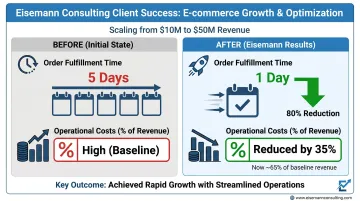
One e-commerce client Eisemann Consulting worked with — scaling from $10M to $50M in 18 months — felt this firsthand. Manual processes broke down, fulfillment delays mounted, and customer satisfaction dropped before the fix was prioritized. After operations were redesigned proactively, order fulfillment time dropped from 5 days to 1 day and operational costs fell 35% as a percentage of revenue.
Build the systems before growth exposes the gaps — not after the gaps have already cost you customers.
How AI and Automation Accelerate Operational Scalability
AI and low/no-code automation tools have brought enterprise-grade process automation within reach of mid-market companies — no IT department required. The distinction between simple and AI-powered automation matters, because each solves a different type of problem.
Simple Automation vs. AI-Powered Automation
- Simple task automation handles rules-based, repeatable work: data entry, routing, notifications, approvals
- AI-powered automation handles more adaptive workflows: pattern recognition, intelligent routing, anomaly detection, conversational interfaces
Tools like Zapier, Airtable, and Retool allow teams to automate handoffs, sync data across systems, and build real-time reporting dashboards without writing a line of code. The no-code market is projected to hit $52 billion in 2026, with 71% of operations teams already adopting these platforms.
Where Automation Delivers the Fastest ROI
For growing businesses, these operational areas consistently show the quickest returns:
- Client onboarding — automated workflows reduce time-to-start and eliminate manual follow-up
- Internal approvals — multi-step approvals that previously took 6+ days can be completed in under 10 hours
- Reporting and dashboards — real-time visibility without manual data compilation
- Email follow-up sequences — no leads fall through the cracks
- Scheduling and task routing — handoffs happen automatically, not when someone remembers
One Eisemann Consulting client — a growing SaaS company managing data entry across five disconnected systems — saved 18 hours per week after Zapier workflows connected their CRM, project management, accounting, and communication tools. The result: 95% reduction in data entry errors and $60,000 in annual operational cost savings.
The Human-AI Balance
Automation handles the repetitive and rules-based. People handle judgment, relationships, and exceptions. The goal is to remove the work that drains time without adding value, so team members stay focused on what actually requires them.
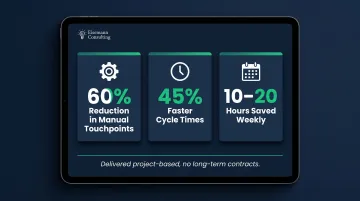
Eisemann Consulting puts this balance into practice through an AI-enabled, human-led model. Mid-market clients typically see a 60% reduction in manual touchpoints, 45% faster cycle times, and 10–20 hours saved weekly — delivered through project-based engagements with no long-term contracts required.
What to Look for in an Operational Scalability Consulting Partner
Only 22% of CEOs report having the team or resource allocation needed to support growth investments, despite the clear desire to scale. That gap — between knowing what needs to change and having the capacity to change it — is exactly where an external partner creates value.
What Separates High-Impact from Generic Consultants
Most operational problems don't need more frameworks. They need someone who can diagnose the actual constraint, not just the surface symptom, and then build the fix.
A high-impact operational consultant:
- Diagnoses root causes rather than presenting generic best practices
- Delivers working solutions rather than recommendations decks
- Has worked with companies at similar growth stages and knows what "good" looks like at scale
- Offers engagement models that match the specific bottleneck — project-based for scoped problems like workflow redesign, ongoing advisory for companies scaling through multiple growth phases simultaneously
How Eisemann Consulting Approaches This
Julie Eisemann brings 26 years of global mobility and operational leadership experience — including direct work with Amazon and Fortune 500 clients — to mid-market companies that need enterprise-caliber thinking without the overhead that comes with it.
The firm's model is built around hands-on delivery — transparent pricing, no long-term contracts, and no engagement that ends with a slide deck. Current offerings include:
- Scalability Accelerator ($15,000 / 3 months) — full operational assessment, process mapping, custom workflow automation, KPI dashboards, and implementation support
- AI Automation Starter ($8,000 one-time) — targets companies ready to eliminate specific manual workflows quickly
For companies not ready to commit, the firm offers a free operational fix within 72 hours — one real bottleneck diagnosed and fixed, no cost, no commitment, limited to five businesses per month. It's a concrete starting point: you walk away with a working fix, not a proposal.
Frequently Asked Questions
What does scaling a business's operations mean?
Operational scaling means growing revenue, customers, and complexity without a proportional increase in cost, manual effort, or operational breakdowns. The distinction from simply getting bigger: efficiency per unit of output improves as the business grows, not deteriorates.
What do business operations consultants do?
Operations consultants diagnose inefficiencies, redesign workflows, implement systems and automation, and help leaders build the infrastructure needed to grow sustainably. The focus is on measurable outcomes — reduced cycle times, lower cost per delivery, fewer manual touchpoints — not generic advice.
What are the most common barriers to operational scalability for growing businesses?
The top barriers include:
- Undocumented manual processes
- Founder-as-bottleneck decision structures
- Lack of real-time financial visibility
- Fragmented tooling across disconnected systems
- Reactive rather than proactive operational planning
Most growing businesses are dealing with at least three of these five at once.
How does AI automation help a business scale its operations?
Automation eliminates repetitive tasks, reduces human error, and accelerates cycle times — freeing your team for higher-value work. The result is significantly more volume handled without proportionally growing headcount or overhead.
When is the right time to hire an operational scalability consultant?
Before growth creates a crisis — typically when manual workarounds are accumulating, margins are shrinking despite revenue growth, or leadership is spending more time firefighting than leading. Waiting until systems are already broken makes the fix far more expensive and disruptive.