Introduction
Your operations team is spending 15+ hours a week re-entering data across disconnected systems. Your weekly reports take half a day to compile. You're hiring to keep up with growth instead of growing smarter. Sound familiar?
This is the operational reality for most mid-market companies — roughly 100 to 1,000 employees — stuck in a gap between manual processes that no longer scale and enterprise IT budgets they don't have. Meanwhile, competitors who've already automated are pulling ahead.
Mid-market companies are actually better positioned for AI adoption than most realize. They can deploy in months, not years. They have enough operational complexity to generate real ROI — but without the approval chains and multi-year IT roadmaps that slow large enterprises to a crawl.
McKinsey's 2024 global survey found that 72% of organizations have adopted AI in at least one function — yet only 39% report measurable results. The gap between adoption and impact is wide open, and mid-market companies that move strategically are the ones closing it.
This article covers where to start, which workflows deliver the fastest ROI, and why deployment sequence matters more than which tools you pick.
Key Takeaways
- Mid-market companies deploy AI pilots in 3–6 months versus 24–36 months for enterprises — a speed window most aren't taking advantage of.
- Highest-ROI automation targets: invoice processing, onboarding, reporting, approval routing, and lead scoring.
- Start with a workflow audit, not a tool purchase — process clarity determines deployment success.
- The 10-20-70 rule says only 10% of AI success comes from the technology — 70% depends on people and change management.
- No data science team? No problem — low/no-code platforms like Zapier, Airtable, and Retool make deployment accessible for any ops team.
Why Mid-Market Companies Are the Sweet Spot for AI Deployment
The Goldilocks Zone Argument
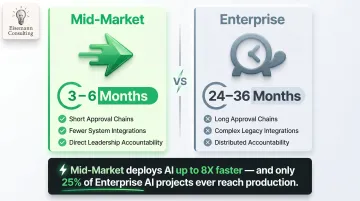
Large enterprises spend heavily on AI but rarely move fast. Their legacy systems, multi-stakeholder approval chains, and 24–36 month rollout cycles mean even well-funded initiatives frequently stall before reaching production. At the other end, small businesses often lack the process volume to justify automation investment.
Mid-market companies occupy a different position entirely. Enough operational complexity to generate real ROI from automation, enough agility to move in weeks. Shorter approval chains, fewer integration dependencies, and leadership that's directly accountable for results.
The numbers support this. Research on mid-market deployment timelines shows a first AI pilot reaching production in 3 to 6 months at mid-market scale, compared to 24 to 36 months for enterprise-wide transformation. Only 25% of enterprises have moved AI pilots to production at all.
The Access Democratization Shift
That structural advantage matters more now because the tools have caught up. A few years ago, building automated workflows required engineering resources, custom integrations, and data science expertise. Today, platforms like Zapier, Airtable, and Retool allow operations teams to automate complex workflows without writing a line of code.
SMEs now hold 57% of the low-code development platform market, and no-code AI adoption among smaller companies is growing at a 38.6% CAGR. Gartner projects that 70% of new business applications will be built using no-code or low-code technologies.
Mid-market companies that move now get to choose their tools before vendors raise prices and the market consolidates. Eisemann Consulting's approach to AI automation is built on exactly this model — using tools like Zapier, Airtable, Retool, Sintra, Base44, and Make to deliver workflow automation results that match enterprise output, without requiring an internal IT department to maintain them.
The competitive window is narrowing. With 42% of companies abandoning AI initiatives before production in 2025 — up from 17% the year prior — the gap between companies that ship and companies that stall is widening fast.
Where AI & Automation Delivers the Biggest Impact
The highest-value automation targets share three characteristics: they touch many people, run frequently, and carry high human error risk. Here's where mid-market companies consistently see the fastest returns.
Operations & Workflow Automation
Manual invoice processing costs between $12.88 and $19.83 per invoice. Automated processing drops that to $2.36 to $2.78 — an 80% cost reduction per transaction. The average manual process also takes 14.6 days to complete versus 3.1 days with automation, and 39% of manually processed invoices contain at least one error, with each correction averaging $53.
A concrete example from Eisemann Consulting's client work: a growing SaaS company was running manual data entry across five disconnected systems — CRM, project management, accounting, and communication tools — consuming 15+ hours per week of staff time. After implementing Zapier workflows connecting all five systems with automated data sync, the result was:
- 18 hours saved per week in manual data entry
- 95% reduction in data entry errors
- $60K in annual cost savings
- A real-time reporting dashboard built in Retool
Workflow automation solves visible problems. AI-powered process mining tools — from platforms like UiPath and Celonis — surface the ones leadership doesn't know exist: where work stalls, who the single points of failure are, and which handoffs create the most delay.
Data & Decision-Making
The shift from monthly reporting to real-time dashboards changes how leadership operates. Instead of reviewing last month's pipeline numbers, sales leaders see live signals: which deals are stalling, where conversion is dropping, and what the forecast looks like today.
McKinsey's data shows that organizations attributing more than 10% of their EBIT to generative AI are predominantly sub-$1B revenue companies — suggesting that focused, data-driven AI deployment at mid-market scale delivers disproportionate financial returns.
Customer Experience & Sales Operations
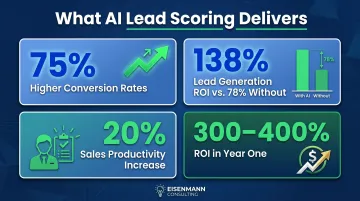
AI lead scoring is one of the most underused capabilities in mid-market sales operations. Only 44% of organizations currently use lead scoring, yet companies implementing machine learning-based scoring report:
- ~75% higher conversion rates versus traditional methods
- 138% lead generation ROI versus 78% without scoring
- 20% sales productivity increase through better prioritization
- 300–400% ROI within the first year of deployment
AI chatbots and email routing add a different layer — the 24/7 availability that previously required much larger support teams. Real-time agent-assist technology reduces issue resolution times by approximately 30%, and 82% of customers prefer interacting with an AI chatbot over waiting on hold.
HR, Onboarding & Compliance Workflows
HR staff currently spend 57% of their time on administrative tasks, and automation can reduce onboarding time by up to 80% — compressing processes that once took a full week down to a single day.
For mid-market companies managing global mobility and immigration compliance, the stakes are higher. These workflows are rule-based, high-volume, and compliance-sensitive — the exact profile where automation consistently performs:
- Offer letters and onboarding checklists
- Visa document tracking and deadline alerts
- Case status updates and handoff notifications
Eisemann Consulting's AI Automation Starter package targets exactly this gap — intake and onboarding automation, document and letter workflows, and integration with existing HR tools — built for mobility and HR teams that don't have dedicated technical staff to manage implementation.
A Practical AI Deployment Framework for Mid-Market Teams
Most mid-market AI initiatives stall for one reason: they start with a tool, not a problem. A Gartner survey of 782 infrastructure and operations leaders found that 57% of AI projects stalled due to poor scoping or overambition, and only 28% of AI use cases fully succeeded. The solution is a disciplined sequence.
Step 1 — Audit Before You Automate
Map your current processes before touching any platform. A workflow audit involves:
- Document each process step: every manual touchpoint, every handoff, every system involved
- Count the time cost: hours per week per person, multiplied by frequency
- Identify error patterns: where do mistakes happen, and what does correction cost?
- Rank by automation potential: highest volume + most rule-based + most error-prone = start here
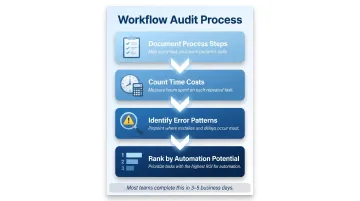
Most teams complete this in 3–5 business days. Eisemann Consulting's process audit (the first deliverable in the AI Automation Starter package) produces an automation roadmap that prioritizes candidates by expected ROI — so clients know exactly where to start before any tool is selected.
Step 2 — Right-Size the Technology
Mid-market companies rarely need custom-built AI solutions. Low/no-code platforms handle the majority of automation needs at a fraction of the cost and implementation time.
Eisemann Consulting uses Zapier, Airtable, Retool, Make, and purpose-built AI platforms like Sintra and Base44 to deliver automation outcomes that previously required an IT department.
Two engagement options match where your company is in that journey:
- AI Automation Starter ($8,000 one-time): Targets specific workflow bottlenecks with 3–5 custom workflows integrated into your existing tools
- Scalability Accelerator ($15,000 for three months): Covers process redesign, tech stack strategy, change management, and fractional COO advisory for broader operational overhauls
Step 3 — Pilot One Process, Measure, Then Scale
Don't automate everything at once. Pick one contained, well-understood workflow and define your success metrics before launch:
- Cycle time (before vs. after)
- Error rate reduction
- Hours saved per week
- Cost per transaction
Quick wins build internal momentum and give leadership concrete evidence before the next phase. The SaaS case study above shows what this looks like in practice — one focused Zapier implementation produced 18 hours per week in savings and $60K in annual cost reduction.
Step 4 — Build a Governance Layer
Every automated workflow needs an owner. Before going live, define:
- Who monitors each workflow for errors
- How exceptions are flagged and escalated
- What the rollback plan is if automation breaks down
In HR, finance, and compliance, automated errors can trigger audits, penalties, or compliance violations — so governance isn't optional.
Step 5 — Optimize Continuously
Getting a workflow live is the beginning of the work, not the end of it. Workflows evolve, team structures change, and AI models improve. Build a quarterly review cadence to identify new automation candidates, refine existing workflows, and measure cumulative ROI against your pre-automation baselines.
The People Side: Why Change Management Determines Deployment Success
The 10-20-70 Rule
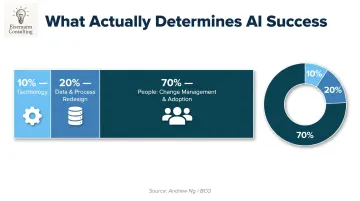
The most useful framework for understanding why AI deployments underperform comes from Andrew Ng; BCG later incorporated it into their AI transformation guidance. The breakdown:
- 10% — Technology (algorithms, tools, infrastructure)
- 20% — Data and process redesign
- 70% — People: adoption behaviors, change management, cultural readiness
An organization can select the best platform, redesign the workflow correctly, and still fail because the people using it daily don't trust it, weren't involved in the design, or received inadequate training. Technology is the easy part.
Gallup's 2026 workforce study (n=23,717 U.S. adults) found that 18% of employees believe AI will likely eliminate their jobs within five years — rising to 23% among employees at organizations already deploying AI. Administrative and office support workers, the roles most targeted by initial RPA and workflow automation, report the highest anxiety levels.
Practical Change Management Tactics
Three approaches reduce resistance and accelerate adoption:
- Involve frontline employees early — the people who run the process daily know where it breaks. Their input improves automation design while creating buy-in before the rollout begins.
- Communicate what changes and what stays — vague messaging about "digital transformation" fuels anxiety. Specific communication about which tasks are automated and which roles evolve gives employees a clear picture of their future in the organization.
- Frame automation as capacity creation — the SaaS company that recovered 18 hours per week didn't eliminate a role; they freed a team member to focus on higher-value work. When employees see automation as relief rather than replacement, adoption follows.
The "AI-enabled, human-led" principle that underpins Eisemann Consulting's approach isn't philosophical positioning — it's operationally important. AI handles rule-based, repetitive work. Humans stay in the decision and relationship roles. That's the division that actually sticks — because it matches how people already think about their own value at work.
Common Mistakes Mid-Market Companies Make with AI Deployment
Mistake 1: Starting with the Tool, Not the Problem
Companies buy a platform or license a product before identifying the specific outcome they want. The result is low utilization, wasted spend, and a team that blames the technology for a scoping failure. Gartner's data is direct: 20% of AI projects fail outright, largely driven by initiatives built around capabilities rather than business outcomes.
Mistake 2: Automating a Broken Process
AI doesn't fix a flawed workflow. It accelerates it. The invoice processing data makes this concrete: with 39% of manual invoices containing errors and corrections averaging $53 each, automating that process without redesigning it first would scale error-correction costs, not eliminate them. Redesign the process first; automation should follow.
Mistake 3: Trying to Do Everything at Once
Scope creep is the fastest way to kill momentum and erode executive confidence. Gartner found that 57% of stalled AI projects were described as overly ambitious. A focused pilot-then-scale approach consistently outperforms broad rollouts in two ways:
- Delivers measurable ROI faster, giving leadership concrete proof points
- Builds internal credibility that makes it easier to expand scope later
Frequently Asked Questions
What is the 10-20-70 rule for AI?
The 10-20-70 rule — attributed to Andrew Ng and independently adopted by BCG — holds that only 10% of AI success comes from the technology, 20% from process and data redesign, and 70% from people: adoption behaviors, change management, and organizational readiness. Technically sound deployments routinely fail when the human side is treated as an afterthought.
Do mid-market companies need a data science team to deploy AI?
No. Modern low/no-code platforms like Zapier, Airtable, and Retool have made AI-powered workflow automation accessible without engineering or data science roles. The critical requirement is process clarity and a disciplined deployment sequence — not technical headcount.
Where should a mid-market company start with AI automation?
Start by auditing your highest-volume, most error-prone processes, then pilot automation on one contained workflow before scaling. Invoice processing, employee onboarding, and data entry across disconnected systems are consistently the highest-ROI starting points.
How long does it typically take to see ROI from AI deployment?
Well-scoped automation pilots typically show measurable results — time savings, error reduction, faster cycle times — within 30 to 90 days. The key variable is scoping quality, not platform selection.
What's the difference between AI and automation?
Rule-based automation (RPA) follows fixed if-then logic for tasks like routing, logging, and data entry. AI-powered automation learns from patterns to handle judgment calls — think email classification, fraud detection, or lead scoring. Most mid-market companies get the best results by starting with workflow automation and layering in AI as their data matures.
How do you prevent AI deployment from disrupting existing teams?
Involve frontline employees in the design process before rollout, and communicate specifically about what changes and what doesn't. Framing automation as something that frees up time — not eliminates jobs — matters far more than any post-launch communication campaign.