Introduction
Most AI automation initiatives don't fail because the technology doesn't work. They fail because organizations skip the hard parts.
According to Gartner, only 28% of AI use cases in infrastructure and operations fully succeed and meet ROI expectations, while 20% fail outright. The remaining majority stall — stuck in pilot purgatory, producing no measurable business value.
For mid-market companies, the stakes are higher. Without dedicated AI teams or enterprise infrastructure, a poorly scoped implementation doesn't just waste time — it erodes confidence in automation altogether.
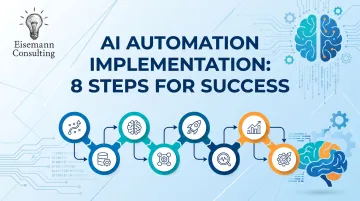
This guide walks operations leaders, HR teams, and mobility professionals through an 8-step framework built on the same decisions that separate stalled pilots from automation that sticks — no dedicated dev team required. Each step front-loads the strategic choices most organizations defer until it's too late.
Key Takeaways
- AI automation implementation starts with strategy — the tool selection comes later
- The most common failure point is skipping process mapping and data readiness to jump straight to tools
- Start with one high-impact pilot; prove value before scaling across the organization
- The right mindset is AI-Enabled, Human-Led — augmentation, not replacement
- Establish your measurement framework before deployment, not after
What Is AI Automation Implementation — And Why It's Hard
Basic workflow automation moves data from point A to point B based on predefined rules. AI automation goes further: it understands context, classifies inputs, and makes decisions. That difference determines whether you're replacing a spreadsheet or actually changing how work gets done.
That confusion drives most failed rollouts. Organizations buy a capable tool, connect it to a few systems, and expect results. What they get instead is an expensive integration that no one fully uses.
McKinsey identified this pattern directly: 80% of companies report using the latest generation of AI, yet the same 80% have seen no significant gains in topline or bottom-line performance. AI adoption and AI value creation are not the same thing.
Why Mid-Market Companies Face a Tougher Path
Mid-market organizations — Series A through C, scale-ups, companies in the 100–500 employee range — carry specific disadvantages:
- No dedicated AI or data engineering team
- Fragmented legacy systems that weren't built to integrate
- Limited budget for failed experiments
- Leadership pressure to show results fast, often before foundations are ready
The fix is a leaner, more deliberate process: front-load the decisions that most implementations skip, and the rest follows.
Steps 1–4: Laying the Groundwork
The first four steps are entirely pre-technology. Getting them right is where most implementations are won or lost.
Step 1: Define Clear Business Goals
Vague goals produce vague results. "Use AI to improve efficiency" is not a goal — it's a direction. Measurable goals look different:
- Reduce invoice processing time by 40%
- Eliminate manual data entry from new hire onboarding workflows
- Cut case status update emails from 3 hours per week to 15 minutes
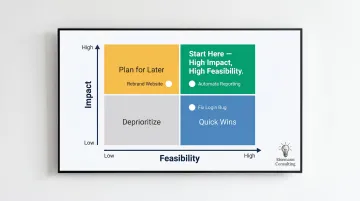
McKinsey's research on high-performing AI organizations shows that the 6% of companies achieving meaningful EBIT impact from AI share one habit: they set both efficiency and growth objectives, then prioritize use cases by business impact and feasibility before committing resources.
A simple two-axis scoring approach works well here: rate each candidate use case on potential time/cost savings (impact) and on how quickly it can be implemented with existing data and tools (feasibility). High impact, high feasibility goes first.
Step 2: Map and Audit Your Core Processes
Before selecting any tool, map what actually happens in your current workflows — not what your SOPs say should happen.
Most organizations discover their documented processes are outdated or incomplete. That's not a problem; it's the point. The mapping exercise itself surfaces bottlenecks, handoffs, and redundant steps that didn't appear in any system.
Strong automation candidates share common characteristics:
- High volume — the task happens dozens or hundreds of times per week
- Rules-based — outcomes are predictable given consistent inputs
- Repetitive — the same steps are followed each time
- Measurable — there's a clear before/after metric available
In operations and HR/mobility contexts, this typically means: data entry across disconnected systems, document intake and routing, status update communications, report generation, and onboarding task sequencing.
Step 3: Assess Your Data Readiness
This is the step most organizations skip — and the most common reason implementations underperform.
McKinsey found that eight in ten companies cite data limitations as a roadblock to scaling AI. Gartner confirms the same finding: poor data quality or limited data availability is a direct cause of AI project failure — not a contributing factor, a direct cause.
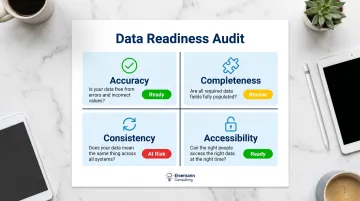
Before selecting a model or platform, audit your data across four dimensions:
| Dimension | Question to Ask |
|---|---|
| Accuracy | Is the data correct and up to date? |
| Completeness | Are there missing fields that would break a workflow? |
| Consistency | Is the same information stored the same way across systems? |
| Accessibility | Is the data structured, centralized, and machine-readable? |
If the answer to any of these is "no" or "mostly," data cleaning and pipeline centralization are prerequisites — not parallel workstreams. Organizations with successful AI initiatives invest up to four times more in data and analytics foundations than those that fail.
Step 4: Build an AI-Ready Team and Change Management Plan
An AI-ready team isn't a technical team. It's a cross-functional one that includes:
- A project owner who is accountable for outcomes, not just delivery
- Subject matter experts: the people who actually do the work being automated
- A leadership sponsor who is visible, vocal about the "why," and able to remove blockers
The human side of implementation is consistently underestimated. McKinsey's research on people readiness is direct: progress is slower than expected when change management is reactive rather than proactive.
Proactive change management means involving employees in designing the automations that affect their workflows — not informing them after the fact. Co-creation increases adoption and catches failure points before they become costly.
That's the core of the AI-Enabled, Human-Led approach at Eisemann Consulting: automation handles the repetitive load while your team retains ownership, judgment, and the ability to modify what's been built.
Steps 5–8: Build, Deploy, and Scale
With groundwork in place, execution can begin. The emphasis should stay on proving value before expanding — every workflow added before the first one is proven increases complexity and risk.
Step 5: Choose the Right Tools and Technology
Tool selection should follow problem definition — not the other way around.
For mid-market companies, low/no-code platforms are typically the right fit. They require no dedicated development team, integrate with existing systems, and can be maintained by operations or HR staff post-implementation.
Zapier, Airtable, and Retool are the core stack Eisemann Consulting uses with clients — chosen because they connect to the workflows clients already have, not because they're the most sophisticated options available.
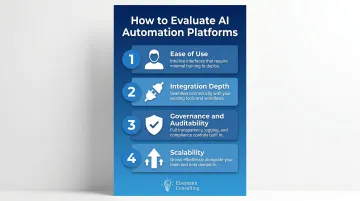
Evaluate platforms on four criteria:
- Ease of use — a non-technical team member should be able to maintain this after handoff
- Integration depth — it must connect to the systems identified in Step 2
- Governance and auditability — you need a clear record of what the automation did and when
- Scalability — the platform should hold up as volume and complexity grow
The most common mistake at this stage is choosing the most impressive platform instead of the most appropriate one. The best first tool is the one your team will actually use.
Step 6: Start with a Pilot Project
A well-scoped pilot does three things: reduces risk, builds internal confidence, and produces the evidence needed to justify broader investment.
Select a process that is:
- High volume (the time savings will be visible quickly)
- Low stakes for errors (mistakes can be caught and corrected without significant consequences)
- Clearly measurable (there's an unambiguous before/after metric)
A successful pilot produces more than just time savings data. It produces a documented workflow that can be replicated, user feedback that surfaces edge cases, and a business case with real numbers — not projections.
Eisemann Consulting's AI Automation Starter engagement is structured exactly this way: an $8,000 one-time implementation that delivers:
- 3–5 custom AI workflows built around your existing systems
- A process audit and automation roadmap
- Team training, documentation, and 30 days of optimization support
- An ROI tracking dashboard
One SaaS client using this approach saved 18 hours per week, reduced data entry errors by 95%, and generated $60K in annual operational savings.
Skipping the pilot and going straight to organization-wide deployment is one of the most expensive mistakes in AI automation. The math is simple: a failed pilot costs weeks; a failed enterprise rollout costs months and organizational trust.
Step 7: Deploy, Monitor, and Measure
Deployment is not the finish line. It's where the real work begins.
Before go-live, establish performance baselines for every KPI you plan to track. Without a baseline, you can't demonstrate improvement — and you can't identify when something breaks.
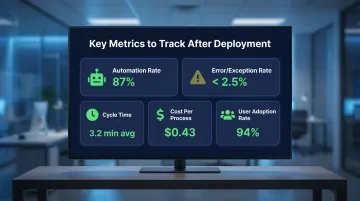
Track these metrics post-launch:
- Automation rate — percentage of tasks completed without human intervention
- Error/exception rate — accuracy and reliability of the automation
- Cycle time — how long the process takes start to finish
- Cost per process — the financial unit economics
- User adoption rate — are people actually using it?
NIST's guidance on deployed AI systems is clear: human-in-the-loop checkpoints aren't optional. Even well-designed automations encounter edge cases. Build feedback loops so frontline users can flag issues quickly — and establish a clear escalation path for exceptions the automation wasn't designed to handle.
Gartner predicts that only 40% of organizations deploying AI will implement dedicated observability tools by 2028. That gap represents a significant portion of teams flying blind on whether their automations are still performing as designed months after launch.
Step 8: Scale, Iterate, and Continuously Improve
Once a pilot is proven, replicate the framework — not just the tool.
Document your automation playbook so each new use case can be onboarded faster than the last. What did you learn about data prep? What integration steps took longer than expected? What user training was most effective? Each answered question shortens the runway for the next rollout.
A few operational realities for scaling:
- Data patterns shift and workflows evolve — schedule quarterly reviews to assess whether automations still reflect how work actually happens
- Business processes change faster than most teams anticipate — an automation built for a 50-person team may need redesign at 150
- New tool capabilities emerge regularly — the platform you selected in Step 5 will have features in 12 months that didn't exist at implementation
McKinsey's research identifies workflow transformation — not just workflow automation — as the differentiator for the 6% of companies that achieve meaningful AI ROI. The goal isn't to automate what you do today. It's to redesign how work flows so the automation is built into something better.
Common Mistakes Growing Companies Make
The Tool-First Trap
Many mid-market companies purchase an AI automation platform before defining what problem they're solving. The result is a tool that connects to systems but doesn't improve outcomes — because no one mapped what outcomes they were targeting.
McKinsey's "Generative AI Value Paradox" puts this in sharp relief: 80% AI adoption, 80% failure to capture value. The tool was deployed. The workflow transformation wasn't.
Over-Automating Too Quickly
Automating multiple workflows simultaneously stretches implementation teams thin, creates technical debt, and makes it nearly impossible to isolate what's working. When something breaks — and something always does initially — you can't tell which automation caused it.
A phased, use-case-by-use-case approach consistently outperforms broad rollouts. Each proven workflow builds the team's confidence and capability for the next one.
Underestimating the Human Side
The 10-20-70 principle from BCG quantifies what most organizations get backwards: 10% of AI success comes from algorithms, 20% from technology and data, and 70% from people and business process transformation.
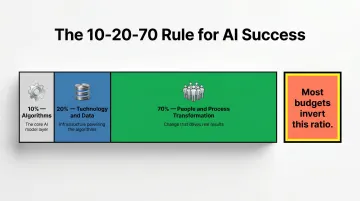
Most implementation budgets invert this ratio — spending heavily on technology and almost nothing on the organizational change required to make it stick.
That gap is where most rollouts stall. Closing it means treating people-side work as a core deliverable:
- Address job security concerns directly before rollout begins
- Communicate the purpose and scope of each automation clearly
- Involve employees in workflow redesign, not just the rollout
Eisemann Consulting's AI-Enabled, Human-Led approach builds these steps into every engagement structure — because the technology is rarely what fails.
Frequently Asked Questions
What are the essential steps for successfully implementing AI automation in business?
The 8 steps are: define measurable goals, map current processes, assess data readiness, build an AI-ready team, select appropriate tools, pilot one workflow, deploy with monitoring, then scale. The pre-technology steps (1–4) are where most implementations succeed or fail — rushing past them to get to software is the most common and costly mistake.
What are the 6 main stages of an AI project lifecycle?
The six commonly referenced stages are problem definition, data preparation, model development, evaluation and validation, deployment and integration, and monitoring and optimization. The 8-step framework in this article maps to these stages with added operational detail for non-technical teams.
What are the 5 D's of automation?
The 5 D's describe the types of work most suited for AI automation: Dull (repetitive tasks like data entry), Dirty (unpleasant work), Dangerous (high-risk tasks), Difficult (complex decision-intensive tasks), and Double time-intensive (tasks requiring speed or precision beyond human capacity). Identifying which D applies to your process helps prioritize automation candidates in Step 2.
What is the 10-20-70 rule for AI?
Developed by BCG, the principle holds that 10% of AI success comes from algorithms, 20% from technology and data, and 70% from people and business process transformation. Most organizations invest heavily in the wrong 30%.
What is the biggest reason AI automation implementations fail?
Unclear objectives, poor data quality, and lack of organizational buy-in are the primary causes — not the technology itself. Gartner reports that many failed AI initiatives collapsed because organizations "expected too much, too fast" without the right preparation in place.
How long does it take to implement AI automation in a mid-market business?
A well-scoped pilot typically shows measurable results within 4–8 weeks. Full implementation across multiple workflows usually takes 3–6 months, depending on data readiness and team capacity. Starting with one high-impact process is always faster than a broad rollout.