Introduction: AI Is Rewriting the Rules of Contract Management
Most mid-market teams manage contracts the same way they did a decade ago — email chains, shared folders, spreadsheets with color-coded renewal dates, and someone's calendar reminder that may or may not fire in time.
That works until it doesn't. And by the time it stops working, you've already missed a renewal, locked into unfavorable terms, or lost hours your team can't get back.
HR, legal, procurement, and operations leaders at growing companies are being asked to do more with less. Contract management is exactly where that pressure shows up — high volume, manually intensive, and rarely prioritized for automation until something breaks.
This guide covers what AI-powered CLM actually means in practice, how it changes each stage of the lifecycle, the measurable business case, and how to start without a full platform overhaul.
Key Takeaways
- Manual contract management costs the average business roughly 9% of contract value annually in leakage alone
- AI automates drafting, review, routing, and obligation tracking, with documented cycle time reductions of up to 83%
- Mid-market teams often see the highest relative ROI from automation, not just large enterprises
- A phased pilot (start with NDAs or vendor agreements) typically takes 4–12 weeks to launch
- The goal is augmentation, not replacement — AI handles the volume work, humans handle judgment
What Is AI-Powered Contract Lifecycle Management?
Contract Lifecycle Management (CLM) is the end-to-end process of managing contracts from initial request through drafting, review, negotiation, approval, execution, obligation tracking, and renewal. Gartner defines CLM as requiring capabilities across all of these stages — including centralized repositories, metadata search, workflow automation, and obligations tracking — not just document storage.
It's a critical operational function. Without it, contracts pile up in inboxes, renewal dates get missed, and no one can tell you what obligations are actually active right now.
AI-Powered vs. Standard CLM
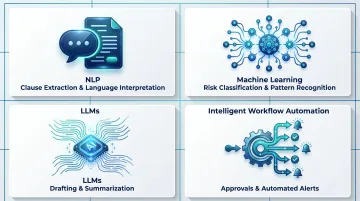
"AI-powered" CLM means applying specific technologies to the manual, judgment-heavy tasks that slow the lifecycle down:
- NLP (Natural Language Processing) — reads and interprets contract language, extracts clauses, identifies obligations
- Machine Learning (ML) — identifies patterns, classifies risk, improves accuracy over time
- Large Language Models (LLMs) — assist with drafting, summarization, and clause suggestions
- Intelligent workflow automation — routes contracts, triggers alerts, and manages approvals without manual intervention
Contract Automation vs. CLM: A Key Distinction
These terms are often used interchangeably, but they describe different things.
CLM covers the entire contract process — from the initial request through renewal and everything in between. Contract automation refers to specific tools or rules that handle discrete tasks within that process: auto-routing for approval, clause population from a template library, deadline alerts.
The distinction matters because automation without lifecycle visibility leaves gaps.
You can have automation without full CLM. But if you're automating approvals while still manually tracking obligations in a spreadsheet, you're still one missed renewal away from a compliance issue.
Why Manual Contract Management Costs More Than You Think
WorldCC research puts the average annual loss from poor contract management at ~9% of contract value. Best performers lose around 3%; worst performers lose 15% or more. For a company with $10M in contracted spend, that's up to $1.5M walking out the door every year.
The per-contract cost is equally striking. WorldCC/IACCM research puts the average cost to process and review a basic contract at $6,900 — a number that compounds fast at volume.
Where Manual CLM Breaks Down
The problems aren't just financial — they're operational:
- Version control chaos — multiple drafts circulating across email threads with no authoritative version
- Missed renewals — auto-renewals executing on contracts that no longer serve the business
- Inconsistent clause language — terms that vary deal-to-deal because no standard library exists
- Slow approvals — contracts sitting in inboxes waiting for routing that happens manually
- No searchable repository — teams can't find active contracts, let alone analyze them
The deeper risk is compounding exposure. Manual processes create compliance gaps, limit visibility into vendor performance, and make it nearly impossible to spot off-contract spend. Left unchecked, these gaps translate directly into regulatory penalties, missed savings, and vendor disputes that take months to unwind.
How AI Transforms Each Stage of the Contract Lifecycle
Contract Creation and Drafting
Manual drafting starts from scratch, or from a template that may be outdated. AI changes the starting point entirely.
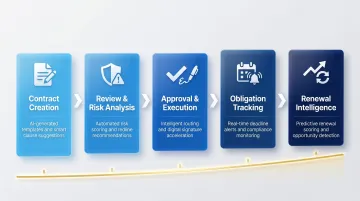
AI-assisted drafting pulls from pre-approved clause libraries, auto-populates standard language based on deal parameters (contract type, counterparty, jurisdiction), and flags missing or non-standard provisions before the document leaves the originating team.
In practice, this compresses first-draft creation from 3–5 days to 4–8 hours on standard agreement types.
The result: legal standards get enforced at the source, not during review.
Contract Review and Risk Analysis
This is where NLP earns its value. Rather than a human reader working through a 40-page agreement under time pressure, AI models scan the full document to:
- Flag clauses that deviate from company playbooks
- Identify semantic inconsistencies (contradictory payment terms, conflicting service levels)
- Assign risk scores based on clause profiles
- Surface issues that fatigued human reviewers routinely miss
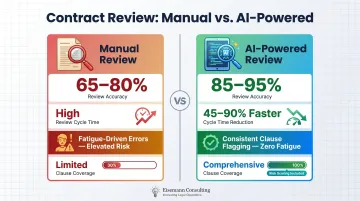
AI playbook-driven redlining cuts review cycles by 45–90% according to compiled benchmarks — and accuracy ranges for AI obligation identification (85–95%) compare favorably to manual review (65–80%).
Approval Workflows and Execution
Manual routing means contracts sit in inboxes waiting for the right person to notice them. AI-driven workflow engines eliminate that by:
- Auto-routing contracts to the correct stakeholders based on type, value, and risk level
- Sending escalation alerts when approvals stall
- Integrating with e-signature platforms to close execution without back-and-forth email
A Forrester TEI study commissioned by DocuSign found contract process time reductions of up to 83% and average turnaround accelerated by approximately 20 days for a composite organization.
Obligation Tracking and Compliance Monitoring
Post-signature is where manual processes most visibly fail. Contracts get filed and forgotten until something expires or goes wrong.
AI monitors active contracts continuously, tracking key dates, deliverable deadlines, and regulatory obligations. Proactive alerts fire automatically:
- Before renewals auto-execute
- Before compliance milestones pass
- Before vendor commitments go untracked
This replaces the calendar reminders and spreadsheet-based tracking that most teams still rely on today.
Renewal and Post-Execution Intelligence
Continuous monitoring generates data that compounds in value. ML builds institutional memory by:
- Identifying which clauses historically led to disputes or cost overruns
- Tracking negotiation outcomes across deals and counterparties
- Surfacing performance patterns to sharpen future templates
Each executed contract becomes an input that improves the next one — grounded in actual outcomes, not assumptions.
The Business Benefits of AI Automation in CLM
| Benefit | What It Means in Practice |
|---|---|
| Efficiency at scale | Manage growing contract volumes without adding headcount |
| Faster revenue capture | Compressed cycle times accelerate deal close, vendor onboarding, and hiring |
| Compliance readiness | AI-enforced templates and automated audit trails replace manual tracking |
| Reduced value leakage | AI detects off-contract spend, missed discounts, and auto-renewals |
| Strategic reallocation | Legal, HR, and ops professionals focus on judgment work, not data entry |
That last row is where the real shift happens. Eisemann Consulting's "AI-Enabled, Human-Led" approach is built on the idea that automation should expand what your team can do, not substitute for their expertise. The goal is getting skilled professionals out of renewal tracking and into negotiations, relationships, and decisions that genuinely require their judgment.
Teams that implement CLM automation well report the same pattern: hours previously spent on administrative contract work shift toward higher-value activity — and that's where the real productivity gains compound.
How to Get Started: Implementing AI in Your CLM Process
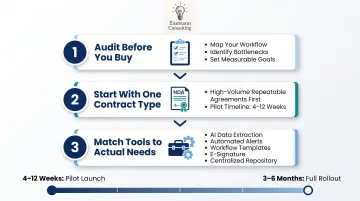
Step 1: Audit Before You Buy
Map your current contract workflow before selecting any tool. Identify where delays, errors, and missed obligations most commonly occur. Define measurable goals — reducing review cycle from X days to Y days, eliminating manual renewal tracking — so you can evaluate results objectively.
The audit doesn't need to be elaborate. For most mid-market teams, the bottlenecks are obvious once you write the process down.
Step 2: Start with One Contract Type
The most common implementation mistake is trying to automate everything at once.
Start with a single high-volume, repeatable contract type:
- NDAs — ideal first candidate; high volume, standard structure, minimal negotiation variance
- Vendor agreements — clear ROI from faster onboarding and obligation tracking
- Offer letters — high frequency in growing HR teams, easily templated
Prove value in one area first, then expand. A realistic timeline runs 4–12 weeks for an initial pilot and 3–6 months for a departmental rollout, depending on tool selection and data quality.
Step 3: Match Tools to Your Actual Needs
Mid-market teams don't need an enterprise CLM platform to start. The capabilities to prioritize:
- AI extraction — pulling key dates, parties, and obligations automatically
- Automated alerts — renewal and milestone notifications
- Workflow templates — pre-built routing for common contract types
- E-signature integration — closing execution without additional steps
- Centralized repository — one searchable location for all active contracts
Low/no-code tools — including Zapier, Airtable, and document workflow platforms — can fill critical gaps for teams not ready to commit to a full CLM platform. Connecting contract generation with e-signature integration, for example, often requires nothing more than targeted workflow automation rather than a full enterprise system.
For teams unsure where their biggest friction points are, an operational workflow audit can pinpoint which contract management steps are costing the most time. Eisemann Consulting's free operational fix offer provides a concrete diagnosis and hands-on improvement within 72 hours — no engagement required to get started.
Clearing Up Common Misconceptions About CLM Automation
"AI will replace our legal or HR team"
It won't — and that's not the point. AI handles the volume-based, rules-driven tasks: extraction, routing, deadline tracking, clause comparison. Human judgment remains essential for complex negotiations, relationship decisions, and exception handling. If your legal team spends 40% of their time on boilerplate review, automation gives that time back for work that actually needs them.
"Automation is only for large enterprises"
Mid-market and SMB organizations often benefit more from automation. Small teams managing high contract volumes have the least margin for manual error. Modern platforms are designed for teams of any size, and the gains are proportionally larger when you're running lean:
- Fewer people means each manual bottleneck costs more in lost hours
- Errors in high-volume contracts compound faster without oversight layers
- Automation scales output without scaling headcount
"Implementation is too complex and expensive for our stage"
Entry costs have dropped significantly over the past few years. Many organizations start with targeted workflow automation — Zapier-based routing, Airtable repositories, e-signature integrations — rather than full CLM platforms. Most teams see measurable payback within the first year — often within the first quarter when they start with the right contract type.
Frequently Asked Questions
What is the difference between contract automation and contract lifecycle management?
CLM is the end-to-end process of managing contracts across their full lifecycle — from request through renewal. Contract automation refers to using technology to execute specific tasks within that process faster and with fewer manual steps. One defines the scope, the other defines the method.
Can small or mid-market companies benefit from AI in CLM?
Yes — and often more than large enterprises. Small operations teams managing growing contract volumes have the least capacity to absorb manual overhead. Modern tools are designed for companies of any size and scale as the business grows.
How long does it take to implement AI-powered contract management?
A first-use-case pilot typically launches in 4–12 weeks. A departmental rollout runs 3–6 months depending on tool selection, contract volume, and existing data quality — starting with a single contract type like NDAs or vendor agreements speeds this up considerably.
Does AI in CLM replace legal teams or contract managers?
No. AI handles high-volume, rules-based tasks — extraction, routing, deadline alerts, clause comparison. Legal and operations professionals retain responsibility for negotiations, exception handling, and judgment-heavy decisions. The role shifts, not disappears.
What types of contracts benefit most from automation?
High-volume, repeatable agreements see the fastest ROI — NDAs, vendor contracts, offer letters, and service agreements top the list. Complex, one-of-a-kind deals still benefit from AI-assisted review, even when full automation isn't practical.
How do I know if my contract management process is ready for AI?
If any of these apply, you're already a strong candidate: tracking contracts in spreadsheets or email, missing renewal dates, spending significant time on boilerplate review, or lacking a searchable contract repository. Most teams find the entry point is simpler than they assumed.