Global ecommerce sales hit US$5.8 trillion in 2023 and are projected to reach US$7.4 trillion by 2025, growing at a 14.7% CAGR through 2030. Meanwhile, the digital transformation consulting market was valued at USD 344.72 billion in 2024 and is on track to nearly triple by 2033. Companies aren't just spending more on technology — they're spending more on expertise to make that technology work.
As AI automation, headless commerce, and workflow orchestration reshape how ecommerce businesses operate, more mid-market companies are turning to specialized digital transformation consultants — not web designers — to rethink operations from the ground up.
This article covers the top ecommerce digital transformation consultants in 2026, what makes each stand out, and how to choose the right fit for your company's stage and goals.
Key Takeaways
- Ecommerce digital transformation covers AI automation, workflow redesign, platform integration, and scalability — not just a website refresh
- The best consultants deliver measurable operational outcomes, not just technology implementations
- Eisemann Consulting is a top pick for mid-market companies that need enterprise-grade expertise without the enterprise price tag or long-term contracts
- Key selection criteria: proven ROI, AI capability, engagement flexibility, and relevant experience at your growth stage
What Is Ecommerce Digital Transformation Consulting?
Ecommerce digital transformation consulting is the strategic process of overhauling how a business runs its online commerce operations — not just redesigning a storefront. That means AI-powered automation, workflow redesign, platform integration, data infrastructure, and scalability planning working together as a system.
The distinction from web design matters. A web agency builds what customers see. A transformation consultant fixes what determines whether the business can grow without hiring an army or watching operations collapse.
The urgency is real. According to McKinsey research, 80% of organizations have begun digital transformations, but only 14% have successfully sustained performance improvements. Legacy system compatibility alone holds up over 40% of transformation projects. Companies that try to self-manage transformation without specialized expertise typically see ballooning costs, missed timelines, and stalled momentum.
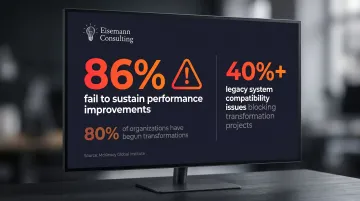
That 86% failure rate has a common cause: strategy without execution. The consultants who move the needle combine a clear methodology with hands-on implementation — not just slide decks and recommendations.
What separates effective transformation consultants from the rest:
- Proven track record of measurable business outcomes (not just deployments)
- AI and automation capability that reduces manual overhead
- Flexible engagement models that fit mid-market budgets
- Change management skills to drive adoption, not just installation
The consultants listed below meet all four criteria — selected for results, not reputation alone.
Top Ecommerce Digital Transformation Consultants in 2026
Eisemann Consulting
Background: Eisemann Consulting is a McKinney, Texas-based strategic consulting firm founded by Julie Eisemann, who brings 26+ years of operational leadership experience — including contributions to $250M+ in cost savings for Fortune 500 and mid-market clients, including Amazon. The firm specializes in AI-powered automation, workflow optimization, scalability consulting, and digital enablement for growing companies.
What sets them apart: Eisemann Consulting fills a specific gap in the market: Fortune 500 methodology at pricing that works for growing companies. Boutique consultants typically lack enterprise rigor; large firms charge accordingly and move slowly. Eisemann operates between both.
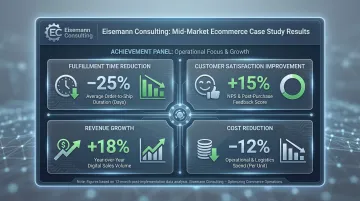
The firm's AI-Enabled, Human-Led approach uses practical low/no-code tools — Zapier, Airtable, Retool — to deliver automations with strong internal adoption rates. For one mid-market ecommerce client scaling from $10M to $50M in 18 months, the engagement delivered:
- Order fulfillment time reduced from 5 days to 1 day
- Customer satisfaction increased from 72% to 94%
- 3x revenue growth with the same operational headcount
- 35% reduction in operational costs as a percentage of revenue
The firm also offers a Free Operational Fix in 72 Hours — a no-commitment engagement where they identify your biggest bottleneck and implement a working fix, not just recommendations. Available to 5 businesses per month.
| Attribute | Details |
|---|---|
| Specialization | AI-powered automation, workflow optimization, scalability consulting for mid-market companies |
| Ideal Client | Mid-market companies (100+ employees), Series A-C startups, scale-ups ready to reduce operational drag |
| Engagement Model | Project-based or ongoing advisory; no long-term contracts; transparent upfront pricing; free 72-hour operational fix available |
Accenture Song
Background: Accenture Song (formerly Accenture Interactive) is one of the world's largest digital transformation consultancies, delivering full-cycle ecommerce transformation for global enterprises. Their capabilities span platform strategy, AI and data integration, customer experience redesign, and omnichannel commerce. In January 2026, Accenture was named a Leader in the inaugural Gartner Magic Quadrant for Digital Technology and Business Consulting Services.
What sets them apart: Scale, cross-industry depth, and proprietary AI frameworks are Accenture Song's primary differentiators. For Telkom Business in South Africa, Accenture Song transformed a printed Yellow Pages directory into a fully functional digital marketplace — 280,000 stores onboarded and 320,000 active users in under one year.
Their integrated "Reinvention Services" model spans strategy through technology implementation and operations, making them well-suited for large-scale, multi-workstream transformations. The trade-off: that scale comes with pricing and engagement timelines that don't fit most growing mid-market companies.
| Attribute | Details |
|---|---|
| Specialization | Enterprise ecommerce strategy, omnichannel transformation, AI/data integration, customer experience redesign |
| Ideal Client | Large enterprises and Fortune 500 companies undergoing full-scale digital commerce transformation |
| Engagement Model | Integrated engagements spanning strategy through operations; pricing not publicly disclosed; typically multi-year enterprise contracts |
Deloitte Digital
Background: Deloitte Digital is the digital consulting arm of Deloitte, offering ecommerce transformation across technology implementation, operating model redesign, digital commerce strategy, and customer journey mapping. They integrate deeply with major platforms including Salesforce Commerce Cloud, SAP, and Adobe. Deloitte was also recognized as a Leader in the January 2026 Gartner Magic Quadrant for Digital Technology and Business Consulting Services.
What sets them apart: Deloitte's strength is connecting ecommerce strategy to broader organizational change — finance, supply chain, operations. For Macy's, Deloitte Digital built a third-party marketplace on macys.com, integrating a new B2B model through 40 internal systems and processes, coordinating 25+ teams and 250+ stakeholders. The fall 2022 launch scaled to 400 unique brands across 20 product categories, including 8 entirely new to Macy's.
That PMO-heavy, enterprise-grade delivery is a strength for complex transformations, though it can slow execution for companies prioritizing speed over coordination.
| Attribute | Details |
|---|---|
| Specialization | Digital commerce strategy, operating model redesign, platform implementation (Salesforce, SAP, Adobe), customer journey optimization |
| Ideal Client | Mid-to-large enterprises needing integrated business and technology transformation tied to broader organizational change |
| Engagement Model | Strategy through implementation and managed services; pricing not publicly disclosed; typically long-cycle enterprise engagements |
Publicis Sapient
Background: Publicis Sapient is a digital business transformation partner known for ecommerce modernization, composable commerce, and AI-driven commerce experiences. They combine strategy, engineering, and data science under one roof. In the Forrester Wave: Commerce Services Q2 2024, Publicis Groupe earned the highest possible score (5.0) in the eCommerce criterion — the only vendor in the evaluation to do so.
What sets them apart: Their SPEED delivery framework (Strategy, Product, Experience, Engineering, Data) emphasizes measurable outcomes with clear revenue accountability. Publicis Sapient also operates on outcome-based commercial models, sometimes investing financially in client projects in exchange for revenue-sharing agreements — aligning incentives in ways traditional consulting models don't.
Results from their ecommerce work include a 23% increase in conversion and 27% revenue increase for Bang & Olufsen using composable commerce architecture, and a marketplace for Homes & Villas by Marriott Bonvoy serving 150 million Bonvoy members.
| Attribute | Details |
|---|---|
| Specialization | Ecommerce modernization, composable/headless commerce, AI-driven personalization, digital revenue acceleration |
| Ideal Client | Mid-market to large enterprises re-platforming or modernizing their commerce stack for speed and scalability |
| Engagement Model | Project-based or outcome-based (revenue sharing); SPEED-driven delivery; pricing not publicly disclosed |
EPAM Systems
Background: EPAM Systems is a global technology services company known for ecommerce platform engineering, AI integration, and full-scope digital commerce development. Their core strength is technical execution — building and migrating complex ecommerce platforms that integrate with legacy ERP, OMS, and PIM systems. EPAM was evaluated in the Forrester Wave: Digital Transformation Services Q3 2025.
What sets them apart: Engineering depth. For Cepheid (a Danaher company), EPAM launched a multilingual B2B ecommerce platform in just six months using composable commerce on commercetools and AWS — enabling healthcare professionals to place orders in two minutes from anywhere in the world. For UK fashion retailer Boden, EPAM led a full platform migration to Shopify, evolving from CMS support into a long-term strategic digital partnership.
EPAM is best suited for companies with clear technical requirements — re-platforming, custom builds, or complex integrations — rather than those needing broad organizational change management.
| Attribute | Details |
|---|---|
| Specialization | Ecommerce platform engineering, custom development, AI integration, platform migration, OMS/ERP/PIM integration |
| Ideal Client | Mid-to-large companies needing technical depth alongside transformation strategy, especially for re-platforming or custom-build projects |
| Engagement Model | Focused platform builds (typically 6+ months) to multi-year strategic partnerships; pricing not publicly disclosed |
How to Choose the Right Ecommerce Digital Transformation Consultant
Choosing a consultant by brand name alone is a reliable way to overpay for results you won't see. A firm built for Fortune 500 complexity is the wrong fit for a Series B company that needs operational fixes this quarter, not next year.
The Right Evaluation Criteria
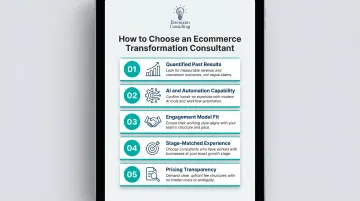
Use these five factors to assess any consultant before committing:
- Quantified past results — Ask for specific numbers: cost savings, cycle time reduction, manual touchpoint elimination. If they can't produce them, move on
- AI and automation capability — Not just awareness of AI tools, but demonstrated deployment in ecommerce-relevant workflows
- Engagement model fit — Does their contract structure, minimum commitment, and onboarding pace match where you are today?
- Stage-matched experience — A consultant whose entire portfolio is $1B+ enterprises may not have the practical playbooks for a $20M operation scaling to $100M
- Transparency in pricing and methodology — Opaque pricing often signals misaligned incentives
Enterprise vs. Mid-Market: Why the Match Matters
Knowing which criteria matter most depends partly on where you sit in the market. The consultants in this list serve very different segments, and choosing the wrong tier costs time and money.
Accenture, Deloitte, and Publicis Sapient at the higher end of its engagements operate at enterprise scale. Their methodologies, pricing, and delivery timelines reflect that. For a company doing a $200M+ platform overhaul touching 40 internal systems, that infrastructure is appropriate.
For a mid-market company with 150 employees and fulfillment operations that are breaking under growth pressure, a boutique firm with focused operational expertise will almost always deliver faster results at a fraction of the cost. Eisemann Consulting's ecommerce case study — 3x revenue growth, fulfillment time cut from 5 days to 1 day, same operational headcount — shows what a targeted engagement can deliver without a multi-quarter rollout.
Conclusion
Ecommerce digital transformation isn't a one-time project. It's an ongoing discipline that requires the right partner at each stage of growth — someone who understands not just the technology, but the business processes and organizational change that make transformation stick.
Look beyond portfolio and brand recognition. Assess flexibility, measurable results at your company's size, and whether they'll let you validate the relationship before committing to a long engagement.
For companies where ecommerce growth is exposing operational gaps — slow fulfillment cycles, fragmented workflows, or teams stretched beyond capacity — the right consultant addresses those underlying systems, not just the storefront. Eisemann Consulting works with mid-market companies and scale-ups on exactly that: operational automation, workflow redesign, and scalability advisory backed by 26+ years of enterprise experience. If you want to see what's slowing your business down, they offer a free operational fix within 72 hours, no commitment required.
Frequently Asked Questions
What is the 80/20 rule in ecommerce?
The 80/20 rule (Pareto Principle) in ecommerce means roughly 80% of revenue comes from 20% of your customers or products. Digital transformation consultants use this insight to prioritize automation and optimization efforts where they drive the most business impact — focusing resources on high-value segments rather than spreading them evenly.
What are the 7 C's of e-commerce?
The 7 C's are: Context, Content, Community, Customization, Communication, Connection, and Commerce. Consultants use this framework to evaluate and redesign the full customer and operational experience, diagnosing which dimensions are underperforming and where to focus improvement efforts.
What does an ecommerce digital transformation consultant actually do?
Unlike web designers, digital transformation consultants analyze and redesign the operational, technological, and strategic foundation of how a company runs its ecommerce business — including AI automation, workflow optimization, platform integration, and scalability planning.
How is ecommerce digital transformation consulting different from hiring a web design agency?
Web design agencies focus on the customer-facing storefront. Digital transformation consultants address the underlying business processes, technology stack, and automation workflows that determine whether a company can scale without costs growing at the same rate.
How long does an ecommerce digital transformation engagement typically take?
Timelines vary by scope — focused workflow automation projects typically run 4–8 weeks, while full-scale operational overhauls can take 6–18 months. Boutique consultants like Eisemann Consulting often offer faster, project-based engagements compared to large enterprise firms with longer discovery and onboarding cycles.
What should a company expect to pay for ecommerce digital transformation consulting?
Enterprise consultancies like Accenture and Deloitte operate on multi-six-figure retainers. Boutique firms are more accessible — Eisemann Consulting's packages start at $8,000 for an AI Automation Starter and $15,000 for a 3-month Scalability Accelerator, with transparent, upfront pricing.